
Learn in your language
PolyYapp teaches Dutch from 7 languages: English, Spanish, French, Polish, Russian, Turkish and Ukrainian. One setting, "Your Language", controls both the interface and the language Dutch meanings are shown in, so a Ukrainian speaker sees Ukrainian meanings in a Ukrainian app, with no English in between. It starts on your phone's language.
iPhone · iPad · Apple silicon Mac
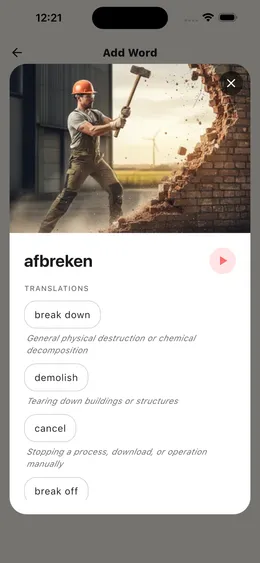
Why it matters for Dutch
Many people learning Dutch in the Netherlands did not grow up with English, and plenty of tools teach Dutch through English only. Learning through a third language adds a layer of translation to every word. Studying from your own language removes it.
How the meanings are made
Meanings are generated with AI for each sense of a word, in your language, the first time anyone needs that word in that language, and then stored. That is why a word can carry several meanings, each with a short note on when it applies and tags such as informal or formal.
Coverage therefore grows as people learn: a word that nobody has studied in your language yet gets its meanings the first time it comes up, and from then on they are there for everyone.
What it does not do
- Dutch is the only language you can learn, for now.
- The dictionary search matches Dutch words, not meanings in your language.
- Meanings are AI-generated, so mistakes happen; the support page says how to report one.
The other features
Spaced repetition
Every lesson is filled first with the Dutch words due for review, then topped up with new ones. Each word climbs its own review schedule.
Exercises
5 exercise types, from recognising a Dutch word to typing it from audio and filling it into a sentence. Harder ones unlock per word.
Your own words
Search the Dutch dictionary, add the words you meet in real life, and they join the same review schedule as everything else.
Daily word game
Guess-a-Word: one hidden Dutch word a day, the same for everyone. Ask yes-or-no questions in Dutch and an AI game master answers.