
Spaced repetition
PolyYapp schedules every Dutch word on its own 14-step review ladder. A lesson of up to 15 exercises is filled first with the words that are due, oldest first, and any free slots go to new words. Get a word right and its next review moves further out; miss it and it drops back one step, not to the beginning.
iPhone · iPad · Apple silicon Mac
How the schedule works
It is a custom ladder of 14 levels, written for PolyYapp, not SM-2 and not FSRS. A new word passes through three quick learning steps, then waits 10 minutes, 1 hour, 3 hours, 12 hours, 1 day, 3 days, 7 days, 14 days and finally 30 days between reviews. The top level counts as mastered.
A correct answer moves a word up one level. A wrong answer, or tapping "I don't know", moves it down one level. Missing a word you knew well therefore costs you one step instead of all your progress, which keeps a bad day from wiping out weeks of work.
What goes into a lesson
Words due for review always come first, starting with the ones that have waited longest. If there is room left, PolyYapp adds new words from its curated Dutch list, and before such a lesson a "New Words" screen shows you what is coming. If there is still room, mastered words come back as practice. The order is then shuffled.
New words are picked at random from the shared list. There are no levels, topics or decks to choose, so you never have to decide what to study next, and you also cannot steer the app towards a particular theme.
Seeing where each word stands
In My Words, every word shows a segmented progress bar for its level and when it is next due: "due now", "review in 3 days", and so on. From the same list you can reset a word to the start, move it to Ignored so it stops appearing, or restore it later.
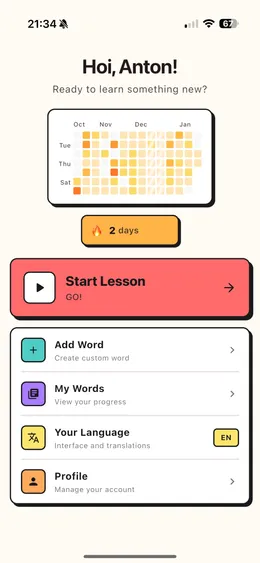
The home screen keeps a daily streak and a heatmap of the last 3 months of practice. Lessons and the daily word game both count towards the streak. Days roll over at midnight UTC, not at your local midnight.
What it does not do
- The schedule is not adjustable: there are no settings for intervals or daily limits.
- New words are random, not ordered by frequency or by CEFR level.
- Lessons, words and audio come from the server, so a connection is needed.
Read more on this
Anki Alternatives for Dutch Without Building Decks
Four apps for Dutch learners who like spaced repetition but not deck-building, what each costs in control, and when to stay with Anki. Checked 31 October 2026.
Best app to learn Dutch vocabulary: 7 apps compared
PolyYapp, ReWord, Anki, Clozemaster, Drops, Memrise and Duolingo compared on how each picks your next Dutch word, your own words, audio and platforms.
PolyYapp vs Anki: Ready-Made Dutch or Full Control
PolyYapp has a curated Dutch word list and no setup. Anki gives full control over cards, scheduling and devices. Where each wins, checked 31 October 2026.
Anki Dutch Deck: Which Kind to Use and How to Judge One
How to pick an Anki Dutch deck: AnkiWeb deck types as of 31 October 2026, five checks (audio, de/het, word source, licence, updates) and a six-step setup.
How to learn Dutch words so they stay learned
A research-backed method for Dutch vocabulary: test yourself, space reviews, learn de or het with each noun, drill separable verbs, listen and use words.
The other features
Exercises
5 exercise types, from recognising a Dutch word to typing it from audio and filling it into a sentence. Harder ones unlock per word.
Your own words
Search the Dutch dictionary, add the words you meet in real life, and they join the same review schedule as everything else.
Daily word game
Guess-a-Word: one hidden Dutch word a day, the same for everyone. Ask yes-or-no questions in Dutch and an AI game master answers.
Learn in your language
Study Dutch straight from English, Spanish, French, Polish, Russian, Turkish or Ukrainian: one setting changes the app and the meanings.