
Dutch words
Learning Dutch words comes down to three things: meet useful words often, learn each noun together with its article (de or het), and review a word just before you would forget it. PolyYapp has about 3,900 curated Dutch words (as of October 2026), shows the article on nouns and forms such as plurals and past tenses where the word has them, and schedules reviews for you.
iPhone · iPad · Apple silicon Mac
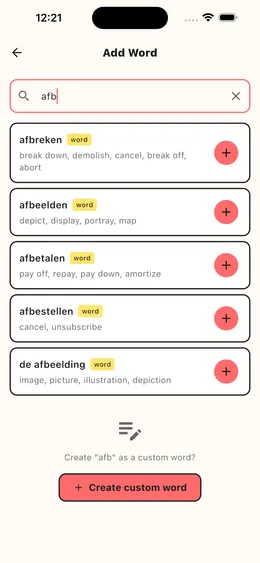
Learn the article with the noun
Dutch nouns take either de or het, and the article changes the words around it. There is no rule that covers every noun, so the reliable habit is to learn "het huis" and "de stoel" as units rather than "huis" and "stoel". On a PolyYapp word card, nouns show their article where the dictionary has it.
Forms belong to the word
A word card also lists forms where they exist: the plural and the diminutive for nouns, the past simple and the past participle for verbs, and a flag on separable verbs such as opbellen, which splits in a sentence ("ik bel je op").
Where the word list comes from
The PolyYapp list was assembled from open Dutch dictionaries and vocabulary lists, then filtered with AI to keep words useful to learners. It is one shared pool: there are no levels or topic decks, and new words arrive at random. Words you add yourself sit alongside them in the same schedule.
Where PolyYapp helps
- Learning nouns with their article and seeing verb and noun forms on each word.
- Reviewing words on a schedule so they stay learned.
- Keeping the words you meet in daily life in one list.
Where it does not
- It does not order words by frequency or by CEFR level.
- It does not show example sentences on the word card; sentences appear only in exercises.
- Search matches Dutch words, not meanings in another language.
Read more on this
De or het? Rules for Dutch articles, with exceptions
When a Dutch noun takes de and when het: the three rules that always hold, the endings that usually decide it, the exceptions, and how to remember the rest.
Most common Dutch words: top 100, plus nouns with de or het
The 100 most frequent Dutch words in the SUBTLEX-NL subtitle corpus, with English meanings, word classes, and de or het for the 30 most common nouns.