
Exercises
PolyYapp has 5 exercise types: translation choice, reverse choice, listening, word scramble and fill in the blanks. Every word starts with the easiest one, recognising its meaning, and the harder types unlock for that word as you answer it correctly, so recall and spelling arrive once recognition is solid.
iPhone · iPad · Apple silicon Mac
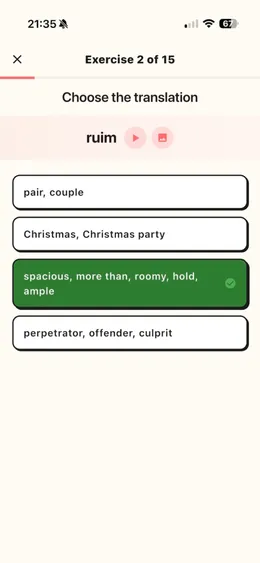
The 5 types
Translation choice shows the Dutch word, plays its audio and asks you to pick the meaning from four options. Reverse choice turns that around: you see the meaning and pick the Dutch word.
Listening plays the word and asks you to type it in Dutch, which is where spelling starts to matter. Word scramble gives you the word's letters out of order inside a Dutch example sentence, and you put them back. Fill in the blanks asks you to type the missing word into a Dutch sentence.
Why the types unlock one by one
Reverse choice opens after your first correct answer on a word. Listening opens after three correct translation answers. The two sentence exercises need three correct answers in total and an example sentence for that word, and fill in the blanks follows two correct scrambles.
Within a lesson the type for each word is picked at random, weighted towards the types you have been getting wrong on that word. The lesson summary shows how many you got right, and a hint reminds you that new exercise types unlock as you master words.
Audio and example sentences
Each Dutch word has pronunciation audio made with text-to-speech in a Netherlands Dutch voice. It is clear and consistent, but it is not a recording of a person.
The example sentences in the scramble and fill-in exercises are generated with AI and cached, each with a translation. They appear only inside those exercises; the word card itself does not list sentences.
What it does not do
- There is no speaking practice, pronunciation scoring or speech recognition.
- There are no grammar lessons; forms appear on the word card, not as drills.
- Guess-a-Word is a separate daily game, not one of the lesson exercises.
Read more on this
Duolingo Alternatives for Dutch, by What You Are Missing
A tracker labels Duolingo's Dutch course A2, taught from English only. Which app fills each gap: grammar, speaking, vocabulary, depth or your own language.
PolyYapp vs Clozemaster: Dutch Words or Sentence Cloze
PolyYapp drills single Dutch words from your first day; Clozemaster drills sentences ordered by word frequency for A2 to C1 learners. Compared 31 October 2026.
PolyYapp vs Duolingo: Course or Vocabulary Trainer
Duolingo teaches a beginner Dutch course with grammar and speaking; PolyYapp trains Dutch words on a visible review schedule. Where each one wins.
PolyYapp vs Memrise for Dutch: word trainer or video course
Memrise teaches Dutch with native-speaker video and AI chat. PolyYapp drills the words you choose with spaced repetition. Where each wins, as of October 2026.
The other features
Spaced repetition
Every lesson is filled first with the Dutch words due for review, then topped up with new ones. Each word climbs its own review schedule.
Your own words
Search the Dutch dictionary, add the words you meet in real life, and they join the same review schedule as everything else.
Daily word game
Guess-a-Word: one hidden Dutch word a day, the same for everyone. Ask yes-or-no questions in Dutch and an AI game master answers.
Learn in your language
Study Dutch straight from English, Spanish, French, Polish, Russian, Turkish or Ukrainian: one setting changes the app and the meanings.