
How to learn Dutch words so they stay learned
Short answer
To learn Dutch words so they stay learned, test yourself instead of rereading, review each word at growing intervals, learn every noun with its article (het huis, de stoel), learn separable verbs together with how they split, hear each word and put it in a sentence, and practise a little every day. PolyYapp, a free iOS vocabulary app, schedules the reviews and the testing for you; it does not teach grammar or speaking.
Key points
- Retrieval beats rereading: in a 2008 Science study, repeatedly testing foreign-language words after they were first recalled had a large effect on recall a week later, while repeatedly studying them had none.
- Wider spacing saves sessions: in a nine-year study of four learners, 13 review sessions 56 days apart gave retention comparable to 26 sessions 14 days apart.
- Practise producing the Dutch word, not only recognising it: in a 2009 study, learning in the productive direction won on five of ten measures of word knowledge, receptive learning on one.
- Learn the article as part of every noun (het huis, not huis) and every separable verb with its split forms (denkt … na, nagedacht, na te denken).
- No study sets a number of new words a day; every new word adds reviews later, so take on only as many as you will keep reviewing.
The research claims on this page come from seven peer-reviewed papers on memory and vocabulary learning, each linked to its DOI and read on 2026-10-31. The Dutch grammar examples come from Gramlink, a Dutch grammar course by Pierre Godin and Marc Piwnik at UCLouvain, read the same day.
What is the best way to learn Dutch words?
The best-supported way to learn Dutch words is to test yourself on them, spread those tests over days and weeks, and practise producing each word rather than only recognising it. A 2013 review of ten study techniques by Dunlosky and colleagues rated practice testing and distributed practice as the only two of high utility, and rated rereading and highlighting as low utility (Dunlosky et al., 2013). For Dutch in particular, add three habits: learn each noun with its article, learn separable verbs with how they split, and hear every word.
Seven habits cover the ways Dutch words get lost: two come from memory research (testing and spacing), one from vocabulary research (producing words), three handle what Dutch adds (articles, separable verbs and sound), and one handles the review load any spaced schedule builds up.
| Habit | What you actually do | What it prevents |
|---|---|---|
| Test, do not reread | Cover the Dutch word and try to recall it before you look | Feeling you know a word you cannot produce |
| Space the reviews | See a word again after a day, then days, then weeks | Forgetting everything a week after a cramming session |
| Produce, not only recognise | Go from your own language to Dutch, and type the word | Understanding a word you can never say or write |
| Article with the noun | Learn “het huis”, never just “huis” | Guessing de or het for years |
| Separable verbs whole | Learn nadenken with denkt … na, nagedacht, na te denken | Not recognising the verb when it splits in a sentence |
| Hear every word | Listen to it, then type what you hear | Knowing a word on paper but missing it in speech |
| Small daily sessions | A short review every day instead of one long one a week | Reviews piling up until you quit |
Why does testing yourself work better than rereading?
Testing yourself works better than rereading because pulling a word out of memory strengthens it, while looking at it again mostly does not. In a 2008 study in Science, students learned Swahili–English word pairs. Once a pair had been recalled correctly, repeatedly studying it had no effect on recall a week later, but repeatedly testing it had a large one (Karpicke and Roediger, 2008). Purdue University’s release on the study reports about 80 percent recall in the repeatedly tested conditions against 36 and 33 percent in the others.
The same study found that students’ predictions of how much they would remember were uncorrelated with how much they actually did. Rereading feels productive, which is the problem. An earlier experiment with prose passages, not vocabulary, showed the same trap from the other side: restudying gave better recall five minutes later, but testing gave substantially better recall after two days and after a week, even though restudying made students more confident (Roediger and Karpicke, 2006).
In practice: never look at the Dutch side of a card first. Say or write your answer, then check. A wrong answer you then correct still counts as practice; a word you only read does not.
How does spaced repetition help you learn Dutch vocabulary?
Spaced repetition helps because a review just before you would forget a word does more than a review while it is still fresh. A 2006 meta-analysis of 839 assessments from 317 experiments found that separating study sessions improves long-term recall, and that the best gap between sessions grows with how long you need to remember (Cepeda et al., 2006). So reviews should start close together and spread further apart as a word settles.
The most striking vocabulary evidence is small but long. Four people learned 300 English–foreign word pairs (French for three of them, German for one) and relearned them over nine years, with sessions 14, 28 or 56 days apart. Longer gaps slowed learning a little, but 13 sessions spaced 56 days apart gave retention comparable to 26 sessions spaced 14 days apart, and retention was tested up to five years after training ended (Bahrick et al., 1993). Half the sessions, comparable retention. The paper also reports that more sessions and longer gaps each helped retention on their own.
A larger study with more than 1,350 people learning facts put rough numbers on the gap: to remember something for a week, the best gap was about 20 to 40 percent of that week; to remember it for a year, about 5 to 10 percent of the year (Cepeda et al., 2008). You do not need to calculate this. A spaced repetition system, whether a box of paper cards sorted by how well you know them or a flashcard app, does the scheduling. What matters is that a word you got right comes back later than one you got wrong.
Should you practise recognising Dutch words or producing them?
Practise producing them. Recognising “huis” when you see it is the easy direction; coming up with “huis” when you need the word for house is the one conversation and writing demand. In a 2009 study of Japanese students learning English word pairs, learning in the productive direction (from their own language to English) gave larger gains on five of the ten measures of word knowledge, including both recognising and producing the written form (orthography), while learning in the receptive direction won only on recognising meaning (Webb, 2009). The author’s conclusion was that if only one direction is used, productive learning may be the more effective.
That study was about English, not Dutch, so take the direction rather than the size of the effect. A sensible order for each new Dutch word:
- See the Dutch word and recall its meaning (recognition, to get started).
- See the meaning and recall the Dutch word (production).
- Hear the word and type it (production with spelling).
- Fill the word into a Dutch sentence (production in context).
Typing matters because it makes you commit to a spelling, which picking from a list of options never does. A word you can only recognise among four choices is a word you may not be able to write.
The article on every noun card
The article goes on every noun card because, as the de or het guide explains, the rules cover only part of Dutch vocabulary and the rest has to be memorised. The cheapest moment to memorise an article is the first time you meet the noun: write “het huis” and “de stoel” on the card, say them that way, and test yourself on the pair.
The cost of skipping the article shows up later. The article decides other words around the noun, and correcting a habit of “de huis” after a year is harder than learning “het huis” on day one.
How should you learn Dutch separable verbs?
Learn a separable verb as a set of forms, not as one infinitive, because in a sentence it often does not look like its infinitive at all. Gramlink’s chapter on separable verbs uses nadenken (to think about): “Zij dacht over het probleem heel lang na” splits it, “Zij heeft over het probleem heel lang nagedacht” puts ge- in the middle, and “Zij beloofde over het probleem na te denken” puts te in the middle (Gramlink, Scheidbare en onscheidbare werkwoorden).
So a card for nadenken should carry the infinitive, a short main-clause example with the particle at the end, the past participle and the te-form. The everyday example is opbellen: “ik bel je op”, “ik heb je opgebeld”.
The harder part is that a verb’s spelling does not tell you whether it splits. Gramlink contrasts aannemen (separable: aangenomen) with aanvaarden (inseparable: aanvaard), and overbrengen (overgebracht) with overwinnen (overwonnen). For particles such as aan-, over-, door- and onder-, the audible clue is stress: separable verbs stress the particle, AANnemen, and inseparable ones the verb, aanVAARden. Gramlink notes an exception when the first part is a noun: stofzuigen is stressed on stof but does not split (gestofzuigd). Learning each verb with its audio and its participle catches most of this without memorising a list.
Does listening help you learn Dutch words?
Yes, because recognising a Dutch word on paper does not mean you will catch it when someone says it. Hearing the word each time you review it ties the sound to the spelling, and typing what you hear tests that link directly. It is also how separable-verb stress, described above, gets learned without a rule.
Listening practice for single words is not listening comprehension. Words in a sentence run together, and recognising them at natural speed needs real audio: podcasts, radio, conversation. Word-level listening makes that easier because you are no longer decoding every word from scratch.
How do you use new Dutch words in sentences?
Use a new word in a sentence about your own life as soon as you can recall it: write one short line, or say it out loud. A sentence makes you produce the word with its article, its forms and its word order, which is exactly what an isolated card does not test. Fill-in-the-blank exercises do a smaller version of the same thing.
Your own life is also the best source of words to learn. A letter from the gemeente, a sign at the station or a word your colleague used are words you will meet again, which a generic list cannot promise. Add them to whatever system you use the same day, with the article or the verb forms attached. For a starting list of high-frequency words, see the most common Dutch words.
How many new Dutch words should you learn a day?
None of the cited studies sets a number of new words per day. The real limit is reviews. Under spaced repetition every new word comes back several times over the following days and weeks, so the reviews you face next month are set by how many new words you take on now. A daily count that feels easy in week one can become a pile of overdue reviews by week four.
Two rules keep it sustainable: do reviews before new words, every day, and add fewer new words when reviews start backing up. Daily matters for the same reason. A spaced schedule makes a few words due every day, so a short daily session clears them on time, while skipping days lets them pile into a long session you are less likely to start. For how this adds up over months, see how long it takes to learn Dutch.
Doing this with PolyYapp
PolyYapp is one way to run the testing, spacing and production parts of this method on an iPhone, iPad or Apple-silicon Mac. PolyYapp schedules every word on a custom 14-step review ladder, from minutes up to 30 days; a correct answer moves the word up one step, and a miss moves it down one step rather than back to the start. Each lesson of up to 15 exercises puts due reviews first and fills free slots with new words.
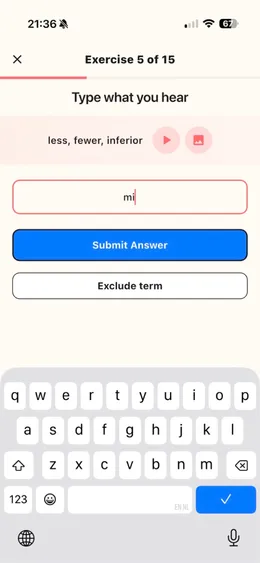
PolyYapp has 5 exercise types, which roughly mirror the order above. Two are multiple-choice recognition: translation choice (pick the meaning from 4 options) and reverse choice (see the meaning, pick the Dutch word). By the standard above, reverse choice is still picking, not recall. The typed production comes from listening (hear the word, type it) and fill in the blanks (type the word into a Dutch sentence); word scramble, in between, has you put the word’s letters back in order. Harder types unlock for a word only after you answer it correctly in easier ones; after that, PolyYapp picks among the unlocked types at random, favouring the ones you have missed on that word. Scramble and fill in the blanks need an example sentence for the word. Where the PolyYapp dictionary has the data, nouns show their article and plural, and verbs show their past forms and a separable flag; every word has text-to-speech audio in a Netherlands Dutch voice.
The curated list has about 3,900 Dutch words (as of October 2026). Adding a word from that dictionary to your own list needs no account; creating a new custom word that is not in the dictionary needs Sign in with Apple and is capped at 10 a day. PolyYapp is free to download and use, with no in-app purchases and no ads today, and needs no account to start.
The limits matter for this method. PolyYapp picks new words at random rather than by frequency, so pair it with a frequency list if order matters to you. It has no grammar lessons and no speaking practice, it needs an internet connection, and it runs only on Apple devices. Paper cards or any flashcard app that tests you on a schedule apply the same research; the tool matters less than doing the reviews. The comparison of Dutch vocabulary apps covers the other options.
Questions
What should I do when I come back to a pile of overdue Dutch reviews?
Work through the overdue reviews before adding any new words, and add none until the pile is gone. Clear a fixed slice each day rather than all of it in one sitting, so every session stays short enough to start. Do not reset the whole deck: the words you still know would lose their long gaps. Words you have forgotten are simply answered wrong, and a spaced repetition system then brings them back sooner, which is the scheduling working as intended.
How should I handle Dutch words I keep getting wrong?
Change the card instead of only repeating it. Add whatever is missing: the article for a noun, the split forms for a separable verb, the audio, or a short sentence you wrote yourself with the word in it. If two words that look alike keep blurring together, put each one in its own example sentence so you meet them in different contexts.
Does it matter which flashcard app I use for Dutch words?
Less than whether you use it every day. A tool does the job if it makes you recall the word before showing the answer, brings missed words back sooner than known ones, and keeps the article and verb forms with the word. Typed answers are a plus because they test spelling. A box of paper cards sorted by how well you know them meets the first two.
Does PolyYapp teach Dutch grammar?
No. PolyYapp is a vocabulary trainer: it shows the article on nouns, forms such as plurals and past participles, and a separable flag on verbs where its data has them, but it has no grammar lessons and no speaking practice. Pair it with a course or a teacher for grammar.