
Best app to learn Dutch vocabulary: 7 apps compared
Short answer
The best app to learn Dutch vocabulary depends on who you want choosing the next word. PolyYapp reviews due words first and adds new ones at random from about 3,900 curated Dutch words (as of October 2026), free today with no ads, on Apple devices only and online only. Clozemaster follows frequency lists, ReWord lets you pick themes, and Anki gives full control and offline study. Memrise and Duolingo set the words for you, and Drops sorts its words into topics but unlocks them one at a time on its free tier.
Key points
- Seven apps, three ways of choosing the next Dutch word: a scheduler over one shared list (PolyYapp), lists you pick by theme or frequency (ReWord, Clozemaster, Anki decks), or an order the app sets (the Memrise and Duolingo courses, and Drops topics, which its free tier unlocks one at a time).
- PolyYapp picks new words at random from its curated list, with no frequency order and no themes; Clozemaster, ReWord and Anki's shared frequency decks all let you start from the most common words.
- Anki, ReWord and PolyYapp let you add your own Dutch words; Clozemaster limits custom content to sentence collections on Pro, and no custom-word feature was found in Drops, Memrise or Duolingo.
- PolyYapp loses on platforms: it has no Android app and needs a connection, while Anki studies fully offline, Drops and Clozemaster offer offline study on their paid plans, and ReWord's listing advertises an offline mode.
- PolyYapp is free today with no ads and no in-app purchases; ReWord, Clozemaster, Drops, Memrise and Duolingo are freemium, and AnkiMobile is a one-time purchase on iOS.
Facts about the other six apps come from each app’s App Store listing, its own website or help pages and its public App Store review feed, read on 31 October 2026, plus third-party reviews and trackers, flagged as third-party where they are used. PolyYapp’s facts come from its code. No app was scored in a hands-on test, so nothing here is a measured result.
Which is the best app to learn Dutch vocabulary?
The best app to learn Dutch vocabulary depends on which column of the table below matters most to you, because each has a different winner. PolyYapp is the only one of the seven with nothing to buy on iOS today, and the only one with no Android app. Anki wins on platforms and offline study, and Clozemaster on frequency-ordered depth. Drops advertises per-word audio by voice artists and Memrise native-speaker video, and Anki, ReWord and PolyYapp are the three that let you add a single word of your own.
| App | How it picks your next word | Your own words | Audio | Platforms | Business model |
|---|---|---|---|---|---|
| PolyYapp | Words due for review first, oldest first; free slots go to new words picked at random from one curated Dutch list. No frequency order, no themes, no levels. | Yes, after Sign in with Apple, up to 10 new custom words a day. | Text-to-speech in a Netherlands Dutch voice for every word, plus a listening exercise where you type what you hear. | iPhone and iPad, and Apple-silicon Macs as the iPad app. No Android app; needs an internet connection. | Free today, with no in-app purchases and no ads. |
| ReWord | You choose a thematic category, including one made of the most commonly used Dutch words; spaced repetition schedules reviews, with no intervals published. | Yes: add, edit, delete and import, per its website. | Not documented for the Dutch edition. | iPhone, iPad, Apple-silicon Mac, Android and Huawei AppGallery; offline mode per its listing. | Freemium with ads and a daily limit; a subscription removes the daily limit, per its listing. |
| Anki (AnkiMobile on iOS) | The deck you download or build decides the words, including Dutch frequency decks on AnkiWeb; SM-2 or opt-in FSRS decides when each card returns. | Yes, any card you make; that is the core use. | Depends on the deck; a template tag adds text-to-speech from the device’s own voices. | iPhone, iPad, Android, Windows, macOS, Linux and the web; fully offline. | Free on desktop and Android; one-time purchase on iOS; no subscription, no ads. |
| Clozemaster | Sentences with one blanked word, in collections ordered by how common the word is; reviews return after 1, 10, 30 and 180 days. | Custom sentence collections on Pro only, not single words. | Text-to-speech sentence audio whose quality depends on the device; listening practice is a Pro feature. | iPhone, iPad, Android and the web; offline downloads on Pro. | Freemium with a daily cap; Pro subscription. |
| Drops | Topic word lists, taught through picture games; the free tier unlocks the next topic list after you finish the current one. | No way to add your own words was found; you can heart words into Favorites. | Per-word pronunciation by professional voice artists, per the listing; no sentence audio. | iPhone, iPad and Android; offline on Premium. | Freemium with a time-capped free tier and ads; Premium subscription. |
| Memrise | An official scenario-based course decides the words; a documented review ladder runs from 4 hours to 6 months. | None found; the course sets the vocabulary. | Native-speaker video clips, the app’s headline feature. | iPhone, iPad, Android and the web; offline study not documented. | Freemium with ads and limited lessons; Pro subscription. |
| Duolingo | A fixed course path; review scheduling is internal and not shown per word. | None; vocabulary comes from the course. | Listening and speaking exercises inside lessons. | iPhone, iPad, Android and the web. | Freemium with ads and an energy limit; Super and Max subscriptions. |
How does each app decide which Dutch word comes next?
Each of these Dutch vocabulary apps answers the question “what do I study now?” in one of three ways, and the choice matters more than any feature list. PolyYapp uses a scheduler over one shared list. ReWord, Clozemaster and Anki hand you lists to pick from, by theme or by frequency. Memrise and Duolingo build the vocabulary into a course you follow in order, and Drops sets the order too on its free tier.
A scheduler over one list means you never decide what to study, and you also cannot steer. PolyYapp fills each lesson of up to 15 exercises with the words due for review first, then tops it up with new words drawn at random. There are no categories, levels or frequency bands to pick. The upside is zero setup; the downside is that a learner who needs work vocabulary this month cannot ask PolyYapp for it.
Lists you pick put you in charge of the pool. Clozemaster’s Dutch collections run from the most common hundred words out past fifty thousand, plus grammar sets on articles, modal verbs and pronominal adverbs. ReWord’s listing describes “thousands of Dutch words and phrases divided into thematic categories” that you can switch at any time. Anki goes furthest: the words are whatever deck you download or write, and you control the scheduler too.
A fixed course decides both the words and their order. Duolingo introduces vocabulary inside its lesson path, and its spaced-repetition model is internal. Memrise teaches the words each scenario needs, then reviews them on a ladder its help centre publishes. Drops sorts its words into topic lists, but its free tier unlocks the next topic only after you finish the current one, so a free learner works through them in the order Drops sets.
Which app suits which learner?
PolyYapp suits iPhone and iPad learners who want zero setup. ReWord suits learners who want to pick themes, including on Android. Anki suits self-directed learners who want control and offline study. Clozemaster suits intermediate learners who want words in sentences. Drops suits visual learners who like short games. Memrise suits learners who want listening and speaking confidence. Duolingo suits complete beginners who want a guided path. Four of these strengths, Android, offline study, video and a grammar course, are things PolyYapp does not offer.
PolyYapp
Best for: learners on an iPhone or iPad who want to open the app and start, with spaced repetition already running. PolyYapp moves each Dutch word along its own 14-step review ladder: a correct answer moves it up one step and a miss moves it down one, never back to the start. Its 5 exercise types unlock per word, from multiple choice to typing what you hear and filling a blank in a Dutch sentence. The word card shows de or het, plurals, diminutives and verb forms where the data has them, and meanings appear in any of 7 languages, so a Polish or Turkish speaker studies Dutch without English in between.
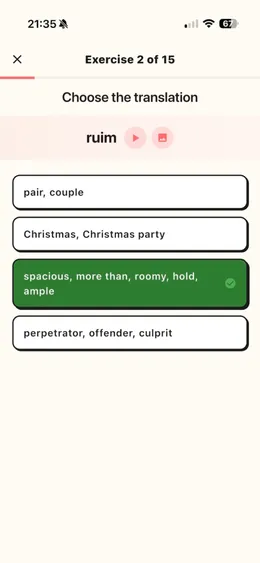
PolyYapp is a vocabulary trainer, not a course. It has no grammar lessons and no speaking practice. It has no Android app, and it needs an internet connection. The review intervals are fixed: you can reset a word’s progress or set it aside, but not change the ladder. More on the schedule is on the spaced repetition page.
ReWord
Best for: learners who want to choose a theme or start from the most common words, on Android as well as iOS. ReWord’s Dutch edition (listed on the App Store as “Learn Dutch with Flashcards!”) organises its words into categories you pick and reviews them with spaced repetition. Its website says you can “add, delete, edit or import” your own words, and the listing advertises an offline mode (App Store listing and reword.app, read 31 October 2026).
Its weak side is what it does not publish. The Dutch word count, the review intervals and the audio are not described anywhere we could find. The free version has a daily limit and shows ads (the App Store listing declares advertising). The listing says the paid full version removes the daily limit, and a question in ReWord’s FAQ implies it removes the ads too. Users in the Netherlands App Store asked in 2024 for words to be shown in example sentences, although the listing promises them.
Anki
Best for: disciplined, self-directed learners who want full control and offline study. Anki ships no Dutch content, so you download a community deck from AnkiWeb or build your own, and you can tune the scheduler, including the opt-in FSRS. It studies fully offline and syncs for free across every major platform. In App Store reviews read on 31 October 2026, users have reported a steep learning curve and shared decks with mistakes; the Anki Dutch deck guide covers how to judge one, and PolyYapp vs Anki sets the two side by side.
Clozemaster
Best for: intermediate learners who want thousands of words in real sentences. Clozemaster blanks one word in a Dutch sentence and orders its collections by how common that word is. By its own description it aims at A2 to C1 and is not meant for complete beginners. The free tier plays a capped number of sentences a day, an account is required, and a wrong answer resets a sentence’s mastery to zero.
Drops
Best for: visual learners who want short, game-like sessions. Drops shows each word as an illustration and drills it through games that a FluentU review describes as tap and swipe, with per-word audio by voice artists. It teaches no grammar or sentences, its free tier is time-capped with ads, and no way to add your own words was found. PolyYapp vs Drops compares the two in detail.
Memrise
Best for: listening and speaking confidence. Memrise builds its Dutch course around scenarios, native-speaker video and AI conversation partners. The course decides the vocabulary, so the words you meet at work or in a letter cannot be added. In App Store reviews read on 31 October 2026, users have reported most lessons sitting behind Pro. PolyYapp vs Memrise goes through both.
Duolingo
Best for: complete beginners who want a free, guided path with grammar and streaks. Duolingo’s whole Dutch course is reachable without paying, with ads and an energy limit. A third-party tracker (DuolingoData, July 2025 snapshot) labels the Dutch course A2 and lists it from English only, and there are no custom words or per-word review dates.
Which apps let you add your own Dutch words?
Three of the seven let you add a single Dutch word you just met: Anki, ReWord and PolyYapp. That matters because the words you need most (from a letter, a colleague or a sign) are rarely the next ones in anybody’s course. Clozemaster’s custom content works at sentence level and is a Pro feature. No custom-word feature was found in Drops, Memrise or Duolingo.
The three differ in effort. Anki is unlimited and entirely manual: you choose the note type and fields and find audio yourself. ReWord documents adding, editing, deleting and importing words and categories. PolyYapp searches its dictionary first; for a word that is not there, it checks the word is real Dutch, reduces it to its dictionary form and generates meanings and forms. That needs Sign in with Apple and is capped at 10 new words a day. The your own words page shows the flow.
Which Dutch vocabulary apps work on Android or offline?
All six other apps run on Android. Anki studies fully offline, Drops and Clozemaster offer offline study on their paid plans, and ReWord’s listing advertises an offline mode. PolyYapp has neither: it runs on iPhone, iPad and Apple-silicon Macs only, and it cannot start without a connection, because lessons, words and audio all come from its server.
Anki is the strongest alternative on both counts: free on Android, Windows, macOS and Linux, and fully offline with media stored on the device. ReWord runs on Android and Huawei devices and its listing advertises an offline mode. Drops offers offline study on Premium, and Clozemaster lets Pro users download collections. Duolingo and Memrise both run on Android and the web; offline study is undocumented for Memrise and reported only by third-party sources for Duolingo’s paid plan.
What does PolyYapp not do?
PolyYapp is built around Dutch vocabulary, not a course, and its gaps decide whether it belongs on your phone at all. It has no grammar lessons, no speaking practice, no exam mode and no CEFR levels. It does not order new words by frequency and offers no themes to choose. Its audio is text-to-speech, not recordings. It teaches Dutch only.
For a learner who wants a course, pair it with one: the how to learn Dutch words guide explains why a vocabulary trainer works best alongside a course or a teacher, and what spaced repetition does and does not do on its own.
What this page could not confirm
The facts below would sharpen this comparison but are not published by the vendors. ReWord does not state its Dutch word count, its review intervals, its free daily limit or whether it has pronunciation audio. Drops publishes no Dutch course size, and sources conflict on its free time cap, so no number is given here. Memrise publishes no Dutch word or level count. Whether Clozemaster’s listening practice covers Dutch is likely but unconfirmed. None of the shared Dutch decks on AnkiWeb was checked card by card.
Questions
Do I need an account to use a Dutch vocabulary app?
Not for PolyYapp or Anki. PolyYapp creates an anonymous profile on first launch, so you can start without signing up; Sign in with Apple is optional and is needed only to create new custom words. Anki needs no account, and an AnkiWeb account is only for its optional free sync. Clozemaster requires an account before you play. ReWord does not document whether it has accounts, and whether Drops requires one could not be confirmed.
Can I learn Dutch vocabulary through a language other than English?
PolyYapp shows Dutch meanings in English, Spanish, French, Polish, Russian, Turkish and Ukrainian. Clozemaster's Dutch course is confirmed from English, with German and French likely but unconfirmed. A third-party tracker (DuolingoData, July 2025 snapshot) lists Duolingo's Dutch course from English only. ReWord's website offers seven native languages, but which of them pair with Dutch was not checked, and in Anki it depends on the deck.
Which Dutch vocabulary app shows whether a noun takes de or het?
PolyYapp's word card shows de or het on nouns where its data has the article, next to plurals, diminutives and verb forms. Clozemaster covers articles as a grammar collection rather than on every word. ReWord documents nothing Dutch-specific such as articles, and in Anki it depends on whether the deck's author added them.