
Inburgering A2 or B1: which level applies to you?
Short answer
Whether your inburgering language exams are at A2 or B1 depends on when your integration requirement started. Before 1 January 2022, the 2013 act applies: level A2 or higher. From 1 January 2022, the 2021 act applies and your municipality's PIP sets the route: the B1 route (B1; the municipality can lower some or all skills to A2 after at least 600 hours of lessons), the education route (B1 or B2) or the Z route (lessons at A1, exams optional). PolyYapp helps only with vocabulary for Reading and Listening.
Key points
- Your start date picks the law: required to integrate before 1 January 2022 means the Wet inburgering 2013 and language exams at A2 or higher; from 1 January 2022, the Wet inburgering 2021 applies and your PIP sets the route and the level.
- Lowering B1 to A2 (afschalen) exists only in the B1 route, needs at least 600 hours of language lessons, and is the municipality's decision; the law allows it for all or only some of the language skills.
- Staatsexamen Nt2 parts already passed at B1 or B2 do not have to be taken again. Under the 2021 act no request is needed if the result is at your PIP level or higher; under the 2013 act you apply to DUO for an exemption.
- Mijn Inburgering, DUO's online service, shows which act applies to you and which exams you have to take.
- At B1 the exam board CvTE's supplementary word list says Staatsexamen Nt2 tasks use only words from the Core and General lists of A Frequency Dictionary of Dutch, plus its own list; its main exam page says most words come from them. DUO publishes no word list for the A2 exams.
- At B1, Listening uses real recordings heard once with no dictionary allowed, so the words have to be recognised instantly. PolyYapp trains vocabulary only, not KNM, Speaking or Writing.
Every rule on this page was read on 31 October 2026 on inburgeren.nl and duo.nl (DUO runs the integration exams), on government.nl, and in the text of the Wet inburgering 2021 on wetten.overheid.nl. Where those official sources say different things, the page says so rather than picking one; the sources are listed at the end.
Which inburgering law applies to me?
The law that applies depends on when you first became subject to the integration requirement. The Wet inburgering 2021 came into force on 1 January 2022 and applies to everyone who first falls under the requirement on or after that date, according to the Dutch government. Anyone who was already required to integrate before 1 January 2022 stays under the Wet inburgering 2013. The 2021 act itself says the same: article 54 keeps the old act in force for the people it applied to on the day before the new one started.
The quickest way to check is Mijn Inburgering, DUO’s online service, which shows the act that applies to you and the date from which you have to integrate. In both systems you normally have 3 years to integrate.
A2 or B1: the level for each route
A2 applies under the 2013 act and B1 on the B1 route of the 2021 act; on the other two 2021 routes, the level is the one your PIP names.
| Your situation | Law | Language level for Reading, Listening, Writing and Speaking | Where your level is fixed |
|---|---|---|---|
| Required to integrate before 1 January 2022 | Wet inburgering 2013 | Level A2 or higher (inburgeren.nl, read 2026-10-31) | Set by the act; Mijn Inburgering lists your exams |
| Required from 1 January 2022, on the B1 route | Wet inburgering 2021 | B1. DUO’s exam table also lists B2 as allowed. The municipality can lower some or all skills to A2 after at least 600 hours of lessons | Your PIP |
| Required from 1 January 2022, on the education route | Wet inburgering 2021 | B1 or B2 according to DUO and the Dutch-language inburgeren.nl page; the English inburgeren.nl page says B1 | Your PIP |
| Required from 1 January 2022, on the Z route | Wet inburgering 2021 | Lessons at level A1. Language exams at A2 are allowed but not compulsory | Your PIP |
What does the 2013 integration act require?
The Wet inburgering 2013 sets the language exams at level A2 or higher. The date your requirement started changes which other exams you take, not the language level; inburgeren.nl lists the exams by start date, and Mijn Inburgering shows yours.
“Or higher” matters. If you already passed one or more Staatsexamen Nt2 parts at B1 or B2, you do not have to take those language exams again; under the 2013 act you apply to DUO for the exemption. At A2, inburgeren.nl says Reading (65 minutes), Listening (45 minutes) and Speaking (35 minutes) are taken on a computer and Writing (40 minutes) with pen and paper.
A dispensation for demonstrable effort (AGI) can release you from the 2013 exams; it does not lower their level.
What does the 2021 integration act require?
Under the Wet inburgering 2021, the municipality decides your route with you. DUO first sends a letter saying you have to integrate. The municipality then holds a broad intake, an interview plus a learnability test (leerbaarheidstoets), and writes your personal integration and participation plan (PIP). The PIP names your route and your exams. There are three routes.
The B1 route prepares you for paid or voluntary work. The 2021 act describes its exam as oral and written Dutch at “at least” level B1 plus KNM, and DUO’s list for the route adds the participation statement process (PVT) and the Labour Market and Participation module (MAP).
The education route is mainly for young people heading to mbo, hbo or university. It includes a language bridging programme (taalschakeltraject), KNM and the PVT, and the act drops the MAP for people who follow that programme.
The Z route (zelfredzaamheidsroute) is for people for whom the other two routes are too hard. Lessons are at level A1, and DUO says the route includes at least 800 hours of language and KNM lessons, the PVT, the MAP and a final interview with the municipality, after which you get a certificate. Language exams at A2 are allowed but optional.
Routes can change. DUO says a switch is possible up to one and a half years after your integration period starts, and from the education route to the B1 or Z route at any time. Any change is recorded in the PIP.
Can the municipality lower B1 to A2?
Yes, but only on the B1 route of the 2021 act, and the decision belongs to the municipality, not to you. Article 17(3) of the Wet inburgering 2021 lets the municipality decide that your oral and written Dutch is examined at A2, “geheel of gedeeltelijk”: for all of the language skills or only some of them. The condition is that you made considerable efforts and still cannot reach B1 within your integration period.
DUO’s guidance for municipalities spells out the threshold. You must have followed at least 600 hours of language lessons at a school with the Blik op Werk quality mark, the municipality checks this, and the lowering (afschalen) is always recorded in the PIP. inburgeren.nl gives the same advice to learners: after at least 600 hours, if B1 is still out of reach, talk to your municipality about scaling down to A2.
In practice that means two things. Registering for an A2 exam on your own does not change your required level; the PIP does. And because the law allows partial lowering, someone strong in Reading but stuck on Writing can end up with a mix of B1 and A2 exams, if the municipality agrees.
Where do I check my own level?
Mijn Inburgering is the official place to check. inburgeren.nl says it shows which act applies to you, from which date you have to integrate and which exams you need. Under the 2021 act, the PIP is the document that counts: inburgeren.nl says it states your exams and the language level for each, and you can read the same in Mijn Inburgering. Under the 2013 act, DUO’s letter gives the date your requirement started, which decides your list of exams.
If what you have read anywhere (this page included) disagrees with your PIP or Mijn Inburgering, those two win.
What changes in vocabulary between A2 and B1?
B1 has an official word basis; A2 has none that this page could find. The College voor Toetsen en Examens (CvTE), which is responsible for the content of the Staatsexamen Nt2, says in its supplementary word list that Programme I (B1) tasks contain only words from the Core and General lists of A Frequency Dictionary of Dutch (Tiberius and Schoonheim, 2013), a learner’s dictionary of the 5,000 most used Dutch words, plus that supplementary list. Its main exam page words it more loosely: most words come from those lists, so treat them as a word base, not a hard limit. DUO publishes no word list for the A2 exams, and no official page read for this article gives a word count for either level. The inburgering word list guide covers both lists and what to learn from them.
In the CEFR descriptions that inburgeren.nl links to, the step up is breadth. An A2 listener understands phrases and the highest-frequency words about their own life: family, shopping, the local area, work. A B1 listener follows the main points of clear standard speech about work, school and leisure.
The exam formats make the same point. These facts are from staatsexamensnt2.nl, which describes the B1 exam (Programme I of the Staatsexamen Nt2, which the B1 route uses):
- Listening has about 40 questions on at least five recordings and lasts 90 minutes. The recordings are real speech, with hesitations, repeats, accents (never a dialect) and sometimes background noise. You hear each one once, you get 25 seconds to read each question first, and no dictionary is allowed.
- Reading has six texts and 36 multiple-choice questions in 110 minutes. A printed Van Dale pocket dictionary for Dutch as a second language is allowed; nothing else is.
- Writing tasks are mostly about work or education, with some about daily life. The same Van Dale pocket dictionary is allowed.
So at B1, Reading forgives a gap in your vocabulary if you have time to look it up, and Listening does not. Words you only half-know on paper are not enough when you hear them once at normal speed. At A2, the exam regulations (examenreglement) treat any aid not expressly allowed in the assignment as an irregularity, and this page found no dictionary permission in them; check your exam invitation letter.
How long it takes to learn Dutch sets out the hour estimates that do exist, with their disagreements.
Where does PolyYapp fit in?
PolyYapp covers one part of this: vocabulary for Reading and Listening, at either level. It is a Dutch vocabulary trainer that brings each word back on a spaced-repetition schedule and drills it with 5 exercise types, from about 3,900 curated Dutch words (as of October 2026). Every word has text-to-speech audio in a Netherlands Dutch voice, and one exercise plays a word and asks you to type it, which trains recognising single words by ear. It is not practice with exam-style recordings; the practice exams are.
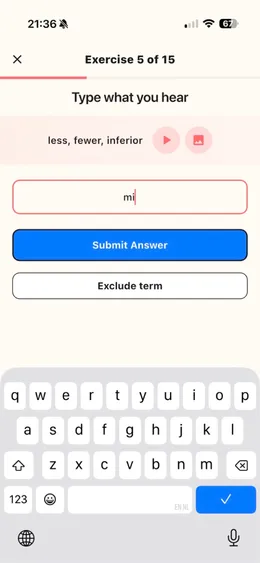
PolyYapp has no levels or topic decks; new words arrive at random from one shared pool, so it does not sort words into A2 and B1, and it does not follow the CvTE lists. Words you meet in a gemeente letter, your PIP or a practice exam can go on your own review list. Creating a word that is not already in the dictionary needs Sign in with Apple and is capped at 10 new words a day.
What PolyYapp does not cover matters just as much here. It does not teach KNM, ONA, MAP or the PVT. It has no speaking or writing practice, and no grammar lessons. It has no exam mode and no mock exams. DUO’s practice exams on inburgeren.nl cover all five A2 parts (Reading, Listening, Writing, Speaking and KNM), and the same page links to Staatsexamen Nt2 practice exams for B1 and B2; those are the place to learn the format. PolyYapp runs on iPhone and iPad, and on Apple-silicon Macs as the iPad app; there is no Android version, and it needs an internet connection. PolyYapp is free to download and use, with no in-app purchases and no ads today.
The B1 language exams and the Staatsexamen Nt2
On the B1 route they are the same exam: inburgeren.nl calls the B1 and B2 language exams the Staatsexamen Nt2. The Staatsexamen also exists outside inburgering, as proof of Dutch for work or study at B1 (Programme I) or B2 (Programme II). On its own it usually does not complete your integration: KNM and the other non-language parts remain, with one exception inburgeren.nl names for some people required to integrate before 1 January 2015. The Staatsexamen Nt2 or inburgeringsexamen guide keeps the two apart.
Where the official sources disagree
Two points differ between official pages read on 31 October 2026, so both versions are given.
- Level on the education route. The 2021 act names B1 only as a minimum: someone who does not complete the education route passes with Dutch at “at least” B1 plus KNM (article 8(4)). The English inburgeren.nl page says B1. The Dutch inburgeren.nl page and DUO’s guidance for municipalities say B1 or B2. government.nl says B1 or higher.
- Length of the B1 Speaking exam. inburgeren.nl says about 30 minutes; staatsexamensnt2.nl says about 25 minutes.
Sources
All read on 31 October 2026.
- inburgeren.nl: Integration in the Netherlands (3 years, PIP, the three routes, scaling down to A2), and the Dutch-language version
- inburgeren.nl: Which exams (2013 and 2021 acts, exams by start date)
- inburgeren.nl: Language exams A2, B1 and B2
- inburgeren.nl: Passed state exam at level B1 or B2
- inburgeren.nl: Took enough lessons and exams (AGI, 2013 act)
- inburgeren.nl: Practicing for the exam (DUO’s A2 practice exams, and the link to the B1 and B2 practice exams)
- inburgeren.nl: Naturalisation
- ind.nl: Civic integration for naturalisation
- inburgeren.nl: A2 exam regulations (PDF, in Dutch)
- DUO: Learning routes under the 2021 act (in Dutch)
- DUO: Exams under the 2021 act (in Dutch)
- DUO: How the Staatsexamen Nt2 works (in Dutch)
- government.nl: Civic integration in the Netherlands and New Civic Integration Act 2021
- wetten.overheid.nl: Wet inburgering 2021, articles 7, 8, 17 and 54 (in Dutch)
- staatsexamensnt2.nl: What the exam looks like (in Dutch)
- staatsexamensnt2.nl: CvTE supplementary word list, with the frequency-dictionary lists each programme uses (PDF, in Dutch)
- internetconsultatie.nl: Draft Besluit naturalisatietoets 2021 (2020 consultation, in Dutch)
- officielebekendmakingen.nl: Motion Boomsma and Rajkowski, Kamerstuk 36704 nr. 68 (2025, in Dutch)
- Erasmus University Rotterdam: CEFR levels (the description inburgeren.nl links to)
Questions
Do I need B1 if I had to integrate from 2021?
No. If your integration requirement started before 1 January 2022, including any date in 2021, the Wet inburgering 2013 applies and the language exams are at level A2 or higher. The B1 route belongs to the Wet inburgering 2021, which applies only to people whose requirement started on or after 1 January 2022.
Can I take the inburgering exam at A2 instead of B1?
Under the 2021 act, only on the B1 route and only if the municipality agrees. DUO says you must first have followed at least 600 hours of language lessons at a school with the Blik op Werk quality mark, and the municipality checks this and records the change in your PIP. Under the 2013 act, A2 is already the required level.
Can I switch from the B1 route to the Z route?
Within limits. DUO says a change of route is possible up to 1.5 years after the start of your integration period, and from the education route to the B1 or Z route at any time during the period. Every change of route is recorded in your PIP.
What if my PIP says A2 for only some skills?
Then those skills are examined at A2 and the rest stay at B1. Article 17(3) of the Wet inburgering 2021 lets the municipality lower the language exams to A2 "geheel of gedeeltelijk", for all of the skills or only some of them, and DUO says the lowering is always recorded in the PIP.
What Dutch level do I need for naturalisation?
inburgeren.nl, read on 31 October 2026, says you first need the integration exam at level A2, or the Staatsexamen Nt2 at B1 or B2. Official texts propose raising this to B1: a 2020 draft decree on the naturalisation test, and a 2025 Tweede Kamer motion asking the government to put that forward. No official page read for this article shows a B1 rule in force, and the IND's own civic integration page, read the same day, also says A2. The IND decides, so check ind.nl again before you plan.
Does PolyYapp prepare you for the A2 or B1 exam?
No. PolyYapp is a Dutch vocabulary trainer: it has no exam mode, no practice exams and no CEFR levels. A larger vocabulary helps with the Reading and Listening exams at either level, which is the part PolyYapp can help with. For the exam format itself, use the practice exams on inburgeren.nl: DUO's own for A2, and the Staatsexamen Nt2 practice exams it links to for B1 and B2.