
Inburgering word list: is there one, and what to learn
Short answer
There is no official word list for the A2 inburgering exams: DUO publishes practice exams but no vocabulary list (checked 2026-10-31). For B1, the CvTE names A Frequency Dictionary of Dutch plus a short supplementary list as the word source. Without a list, learn high-frequency words first, then the words of the exam themes: municipality, housing, work, health and school. This page gives a themed starter list of about 130 words with de or het. PolyYapp follows no exam list: it teaches about 3,900 curated Dutch words (as of October 2026) in random order.
Key points
- DUO publishes no vocabulary list for the A2 inburgering exams. Its free A2 practice exams on inburgeren.nl are the closest thing to an official guide to the words that come up.
- For the B1 Staatsexamen Nt2 (Programme I), the CvTE's supplementary word list says tasks use only words from the Core and General lists of A Frequency Dictionary of Dutch plus its own list of just under 300 words; its main exam page says most words come from them.
- Learn high-frequency words first, then the words of the exam themes: the gemeente, housing, work, health and school.
- Learn every Dutch noun with its article (de or het); there is no rule that covers every noun.
- The B1 and B2 Listening exams allow no dictionary, so train recognising each word by ear, not only on paper.
- PolyYapp has no inburgering list, no themes and no exam mode. You can search its dictionary for the words below and add them to your own review list.
The exam facts on this page were checked on 31 October 2026 against inburgeren.nl (DUO), staatsexamensnt2.nl and the Besluit inburgering 2021 on wetten.overheid.nl. The article (de or het) of every noun in the word list was checked the same day against the Woordenlijst Nederlandse Taal at woordenlijst.org.
Is there an official word list for the inburgering exam?
There is no official inburgering word list for the A2 exams. DUO, which runs the inburgering exams, publishes free A2 practice exams for Writing, Speaking, Listening, Reading and Knowledge of Dutch Society (KNM) on inburgeren.nl, plus the exam regulations, and neither page links to a vocabulary list. A search of inburgeren.nl found none either (checked 2026-10-31).
One document there is called “Woordenlijst”, which is why people go looking. It belongs to the ONA exam (Orientation on the Dutch Labour Market) and explains the terms used on the ONA result cards, words such as arbeidsmarkt (labour market) and beroep (occupation), each with an example sentence. It is a glossary for that portfolio, not a list of words that the Reading or Listening exam draws on.
The B1 and B2 language exams are different, and the next section covers them.
Which words does the B1 exam use?
The B1 language exam has a published vocabulary basis. inburgeren.nl notes that the language exams at B1 and B2 are also known as the Staatsexamen Nt2 (Dutch as a second language state exam), and the Besluit inburgering 2021 (article 3.5) says the B1 language exam follows the state exam’s rules. A list published on staatsexamensnt2.nl by the College voor Toetsen en Examens (CvTE) says:
- The exam uses the word lists of A Frequency Dictionary of Dutch (Tiberius and Schoonheim, 2013), a dictionary for learners of the 5,000 most used Dutch words, sorted into six lists: Core, Fiction, Newspapers, Spoken, Web and General.
- Programme I (B1) tasks contain only words from the Core and General lists.
- Programme II (B2) tasks can use words from all six lists, so the whole 5,000-word dictionary.
- The CvTE adds a supplementary list of its own, just under 300 entries, whose words can also appear in both programmes. It includes gemeente, burgemeester, boete, handtekening, bankrekening, pinpas, rijbewijs, afzeggen and inschrijven.
The dictionary’s authors describe Core as the words that are frequent in all four of their genres (fiction, newspapers, spoken Dutch and the web) and General as the next band, frequent in at least three; the other four lists hold words that are frequent in one genre. The dictionary itself is a book in the Routledge Frequency Dictionaries series, according to the same authors; the CvTE publishes only its own supplementary list.
The CvTE’s main exam page, “Wat is het Staatsexamen Nt2?”, words this more loosely than the supplementary list does. It says most words in Programme I come from the Core and General lists or the supplementary list, and most words in Programme II come from the dictionary or the supplementary list. The two CvTE documents disagree on “only” against “most”, so read the lists as the exam’s word base rather than a hard limit.
The CvTE also says, in its answers to candidates’ questions, that some words in the exams are not in the permitted dictionary, that exam texts are written so that the meaning of a likely unknown word can be worked out from the text or is not needed for the answer, and that you do not need to know every word in an exam to answer the questions.
This table sets the four exams side by side. Only the B1 and B2 exams name a word source; the A2 language exams and KNM do not.
| Exam | Published word source |
|---|---|
| A2 language exams (DUO): Reading, Listening, Speaking, Writing | None found on inburgeren.nl (checked 2026-10-31) |
| B1 Staatsexamen Nt2, Programme I | Core and General lists of A Frequency Dictionary of Dutch, plus the CvTE supplementary list (“only” in the list, “most words” on the CvTE’s main exam page) |
| B2 Staatsexamen Nt2, Programme II | Words from all six lists of A Frequency Dictionary of Dutch (the whole dictionary), plus the CvTE supplementary list (“only” in the list, “most words” on the main exam page) |
| Knowledge of Dutch Society (KNM) | No word list; the Besluit inburgering 2021 names eight subjects instead |
Which level applies to you depends on when your obligation started and on your personal plan; the guide inburgering: A2 or B1? explains how to check, and the Staatsexamen Nt2 or inburgeringsexamen guide covers the exam rules, including the one dictionary allowed at B1 and B2.
Which Dutch words help most for Reading and Listening?
Two layers of vocabulary help most: the high-frequency everyday words every text is built from, and the words of the situations the exams keep returning to. Frequency comes first because the small words (omdat, maar, als, niet) appear in almost any text, whatever its subject, and the B1 word base is itself drawn from a frequency dictionary. The guide to the most common Dutch words covers that first layer.
The second layer is themed. The official sources name the situations:
- KNM subjects. Article 3.4 of the Besluit inburgering 2021 lists eight: werk en inkomen (work and income), omgangsvormen, waarden en normen (manners, values and norms), wonen (housing), gezondheid en gezondheidszorg (health and health care), geschiedenis en geografie (history and geography), instanties (official bodies), staatsinrichting en rechtsstaat (government and the rule of law) and onderwijs en opvoeding (education and upbringing).
- A2 Writing. inburgeren.nl describes four assignments, such as writing a short letter or filling in a form.
- B1 and B2. staatsexamensnt2.nl says the Listening exam’s speakers talk about situations at work, in study or in daily life, and that most Writing assignments are about work or education.
KNM itself is a knowledge exam, and knowing the words for its subjects is not the same as knowing the answers. The themes are used here because the same vocabulary turns up in the letters, forms and conversations of the language exams.
A themed inburgering word list to start with
The list below is a starter set of about 130 words in nine groups, chosen for this page around the themes above. It is not an official list, and it does not replace the frequency layer. Every noun carries its article, checked against woordenlijst.org on 2026-10-31, because the article is part of the word: you say het huis and de woning, and the words around a noun change with it.
At the gemeente and in official letters
These are the words of appointments, registrations and post from the municipality or another official body.
| Dutch | English |
|---|---|
| de gemeente | the municipality (your town or city council) |
| het gemeentehuis | the town hall |
| de afspraak | the appointment |
| het loket | the service desk or counter |
| het formulier | the form |
| de brief | the letter |
| de aanvraag | the application (for a permit or an allowance) |
| de inschrijving | the registration |
| het adres | the address |
| de handtekening | the signature |
| het identiteitsbewijs | the proof of identity |
| de verblijfsvergunning | the residence permit |
| de belasting | tax |
| de toeslag | the allowance (a government contribution, for example towards rent or care) |
| de boete | the fine |
Housing (wonen)
These cover renting, neighbours and the things that break in a home.
| Dutch | English |
|---|---|
| het huis | the house |
| de woning | the home, the dwelling (the word in official letters) |
| de huur | the rent |
| de huurder | the tenant |
| de verhuurder | the landlord |
| het huurcontract | the rental contract |
| de borg | the deposit |
| de woningcorporatie | the housing association |
| de buurt | the neighbourhood |
| de buurman / de buurvrouw | the neighbour (man / woman) |
| de verhuizing | the move (to a new home) |
| het huisvuil | household waste |
| de verwarming | the heating |
| de lekkage | the leak |
| de sleutel | the key |
| de rekening | the bill (also: the bank account) |
Work and income (werk en inkomen)
These are the words of job adverts, contracts and payslips.
| Dutch | English |
|---|---|
| het werk | work |
| de baan | the job |
| de werkgever | the employer |
| de werknemer | the employee |
| de collega | the colleague |
| het salaris | the salary |
| het loon | the wage |
| het contract | the contract |
| de vacature | the vacancy |
| de sollicitatie | the job application |
| het sollicitatiegesprek | the job interview |
| het uitzendbureau | the temp agency |
| de dienst | the shift (also: the service) |
| de uitkering | the benefit (social security payment) |
| de stage | the internship |
| de vrijwilliger | the volunteer |
Health and care (gezondheid en zorg)
These are the words for the GP, the pharmacy and health insurance.
| Dutch | English |
|---|---|
| de huisarts | the GP, the family doctor |
| de doktersassistent | the doctor’s assistant |
| het spreekuur | the consulting hours |
| de huisartsenpost | the out-of-hours GP service |
| het ziekenhuis | the hospital |
| de apotheek | the pharmacy |
| het recept | the prescription (also: the recipe) |
| de medicijnen | medicines (a plural, so always de) |
| de zorgverzekering | the health insurance |
| de tandarts | the dentist |
| de verloskundige | the midwife |
| de klacht | the complaint (a symptom, or a formal complaint) |
| de pijn | pain |
| de koorts | fever |
School and children (onderwijs en opvoeding)
These are the words of school letters, parents’ evenings and childcare.
| Dutch | English |
|---|---|
| de basisschool | the primary school |
| de school | the school |
| de leraar | the teacher |
| de klas | the class |
| het kind | the child (plural: de kinderen) |
| de ouder | the parent |
| het huiswerk | homework |
| het rapport | the school report |
| de kinderopvang | childcare |
| het consultatiebureau | the child health clinic (check-ups for babies and toddlers) |
| de leerplicht | compulsory schooling |
| de opleiding | the training, the course of study |
| de cursus | the course |
| het diploma | the diploma |
Daily life and getting around
These are the words of shopping, transport and social life.
| Dutch | English |
|---|---|
| de supermarkt | the supermarket |
| de boodschappen | the groceries (a plural, so always de) |
| de bon | the receipt |
| de pinpas | the debit card |
| het station | the station |
| de trein | the train |
| de bus | the bus |
| het kaartje | the ticket (a diminutive, so always het) |
| de fiets | the bicycle |
| het weer | the weather |
| de verjaardag | the birthday |
| het feest | the party |
The country and the state
These cover the KNM subjects of history, geography, government and the rule of law.
| Dutch | English |
|---|---|
| het land | the country |
| de provincie | the province |
| de regering | the government |
| de verkiezing | the election |
| de wet | the law |
| de grondwet | the constitution |
| de politie | the police |
| de rechter | the judge |
| de koning | the king |
| de geschiedenis | history |
| de vrijheid | freedom |
| de gelijkheid | equality |
| de discriminatie | discrimination |
| de dijk | the dike |
| het water | water |
Verbs from letters and forms
Verbs have no article, but many are separable: the first part moves to the end of a short sentence (ik vul het formulier in). The separable ones are marked.
| Dutch | English |
|---|---|
| aanvragen (separable) | to apply for |
| invullen (separable) | to fill in |
| ondertekenen | to sign |
| zich inschrijven (separable) | to register |
| afzeggen (separable) | to cancel (an appointment) |
| opzeggen (separable) | to end (a contract or subscription) |
| verlengen | to extend, to renew (a permit or contract) |
| betalen | to pay |
| verhuizen | to move house |
| solliciteren | to apply for a job |
| ophalen (separable) | to collect, to pick up |
| meenemen (separable) | to bring along |
| bellen | to phone |
Small words that carry the meaning
Reading and Listening questions often turn on a condition, a reason or a deadline, and these words are where that lives in a sentence.
| Dutch | English |
|---|---|
| omdat | because (the verb moves to the end of the clause) |
| want | because, for |
| maar | but |
| dus | so |
| daarom | that is why |
| toch | still, anyway, after all |
| behalve | except |
| alleen | only |
| niet meer | no longer |
| nog niet | not yet |
| uiterlijk | at the latest |
| vanaf | from (a date or time) |
| binnen | within |
| verplicht | compulsory |
| gratis | free of charge |
How do you study an inburgering word list?
Study an inburgering word list a little every day rather than in long sessions, and test yourself on recall instead of rereading. Four habits do most of the work.
- Learn every noun with its article. Memorise de huur and het huurcontract, never huur and huurcontract. No rule covers every noun; the guide to de or het covers the patterns that do exist.
- Hear every word, and spell what you hear. The B1 and B2 Listening exams allow no dictionary, and no dictionary allowance was found in the A2 rules, so a word you can read but not catch by ear will not help you in Listening. Say each word aloud and write it down from audio.
- Review on a schedule. Bring each word back just before you would forget it; the guide on how to learn Dutch words covers the method.
- Add the words you actually meet. A letter from the gemeente, a rental contract or a DUO practice exam will contain words that no starter list has. Those are the ones worth adding, because they are the ones your life and your exam use.
Then do the official A2 practice exams on inburgeren.nl, or the B1 and B2 practice exams linked from the same page, early. They show which words cost you points, which no list can predict.
Does PolyYapp cover the inburgering word list?
Only partly, and by overlap rather than design. PolyYapp teaches about 3,900 curated Dutch words (as of October 2026) from one shared pool. New words arrive in random order, with no themes, no levels and no link to the frequency dictionary the B1 exam uses, so there is no way to choose “housing” or “work” and study only that. PolyYapp has no exam mode and does not cover KNM, Speaking or Writing.
What PolyYapp does fit is the study routine above. Its search matches Dutch words, so you can look up a word from these tables and, if it is in the dictionary, add it to your own review list; anyone can add a word that is in the dictionary, without an account. Creating a word that is not in the dictionary needs Sign in with Apple, up to 10 new words a day.
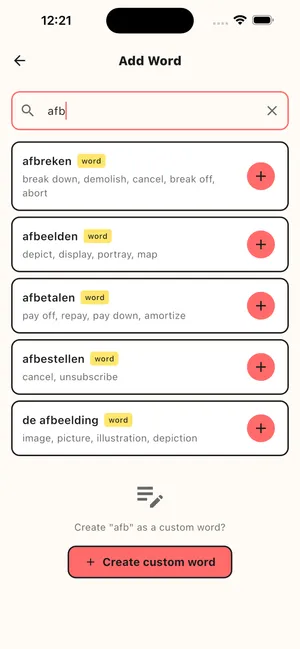
PolyYapp shows the article (de or het) on nouns where its dictionary has it, plays text-to-speech audio in a Netherlands Dutch voice for every word, and has a listening exercise in which you hear the word and type it. It schedules reviews on a 14-level ladder and drills each word with 5 exercise types. PolyYapp is free with no in-app purchases and no ads today. It runs on iPhone and iPad, and on Apple-silicon Macs as the iPad app; there is no Android version, and it needs an internet connection.
For grammar, speaking and writing, a course or an inburgering school does what a vocabulary app cannot. The comparison of apps for inburgering sets out which tool covers which exam part.
Sources
All checked on 2026-10-31.
- inburgeren.nl (DUO): Language exams A2, B1 and B2, the format of each A2 exam and the note that B1 and B2 are the Staatsexamen Nt2.
- inburgeren.nl (DUO): Practicing for the exam, the A2 practice exams for Writing, Speaking, Listening, Reading and KNM.
- inburgeren.nl (DUO): Knowledge exams, KNM and the ONA glossary (“Woordenlijst”).
- inburgeren.nl (DUO): Examenreglement, the rules for the A2 exams, including that any aid not expressly allowed counts as an irregularity.
- wetten.overheid.nl: Besluit inburgering 2021, article 3.4 (the eight KNM subjects) and article 3.5 (the B1 exam follows the Staatsexamen Nt2 rules).
- staatsexamensnt2.nl: Aanvullende woordenlijst Staatsexamen Nt2, the CvTE’s statement of which frequency-dictionary lists each programme uses, and its supplementary list.
- staatsexamensnt2.nl: Wat is het Staatsexamen Nt2?, which says most words in Programme I and II come from the frequency dictionary or the supplementary list.
- Tiberius, Schoonheim and Kilgarriff, A Frequency Dictionary of Dutch (eLex 2013 paper), how the Core, General and genre lists are defined and the Routledge Frequency Dictionaries series.
- staatsexamensnt2.nl: Hoe ziet het examen eruit? and Vragen van kandidaten, the dictionary rules per exam part and the note that you need not know every word.
- Woordenlijst Nederlandse Taal, the article of every noun in the tables.
Questions
Does the Staatsexamen Nt2 have an official word list?
Partly. The College voor Toetsen en Examens (CvTE) names A Frequency Dictionary of Dutch (Tiberius and Schoonheim, 2013) as the word source and publishes a supplementary list of its own. Its two documents differ in strength: the supplementary list says B1 tasks use only words from the Core and General lists, while its main exam page says most words come from them. The dictionary itself is a commercially published book, not a free list.
How many Dutch words do I need for the inburgering exam?
No official number exists for the A2 exams. For B1, the CvTE points to the Core and General lists of a frequency dictionary of the 5,000 most used Dutch words, plus its supplementary list (only those words, says the list; most words, says its main exam page). It also states that you do not need to know every word in an exam text: unknown words are either explained by the context or not needed for the answer.
Can I use a dictionary during the inburgering exam?
At B1 and B2 (Staatsexamen Nt2), only the Van Dale Pocketwoordenboek Nederlands als tweede taal is allowed, and only in Reading and Writing. No dictionary is allowed in Listening or Speaking. DUO's A2 exam regulations treat any aid not expressly allowed in the assignment as an irregularity, and no dictionary permission was found in them, so check your exam invitation letter.
Which topics should an inburgering word list cover?
The Besluit inburgering 2021 names eight subjects for the KNM exam: work and income; manners, values and norms; housing; health and health care; history and geography; official bodies; government and the rule of law; and education and upbringing. Add the everyday situations the language exams use, such as letters, forms, appointments and shopping.
Does PolyYapp have an inburgering word list?
No. PolyYapp teaches about 3,900 curated Dutch words (as of October 2026) from one shared pool, and new words arrive in random order, with no themes or levels. What you can do is search for a Dutch word from a list like the one on this page and add it to your own review list. PolyYapp has no exam mode and does not cover KNM, Speaking or Writing.
Is the Woordenlijst PDF on inburgeren.nl a vocabulary list for the exam?
No. The PDF called "Woordenlijst" on inburgeren.nl belongs to the ONA exam (Orientation on the Dutch Labour Market) and explains terms used on the ONA result cards, such as arbeidsmarkt and beroep. It is a glossary for that portfolio, not a list of words for the Reading or Listening exam.