
PolyYapp vs Babbel: grammar course or Dutch word trainer
Short answer
PolyYapp and Babbel do different jobs. Babbel is a subscription Dutch course from A1 to around B1, with grammar taught in order, dialogues, speech recognition, native-speaker audio and downloadable lessons, on iOS, Android and the web. PolyYapp is a free iOS vocabulary trainer with no ads or in-app purchases today: spaced repetition, 5 exercise types and about 3,900 Dutch words, but no grammar lessons and no speaking practice. Pick Babbel to be taught Dutch; add PolyYapp to make the words stick.
Key points
- Babbel is a course and PolyYapp is a vocabulary trainer: Babbel teaches grammar, dialogues and pronunciation from A1 to around B1, while PolyYapp drills words and teaches no grammar.
- Babbel wins on speaking (speech recognition), audio recorded by native Dutch speakers, offline lessons, Android and the web. PolyYapp uses text-to-speech, needs a connection and runs only on Apple devices.
- PolyYapp needs no account to start and shows meanings in 7 languages, including Polish, Russian, Turkish and Ukrainian, which Babbel's Dutch course is not known to offer.
- Babbel is a subscription with a free first lesson and no ongoing free tier; PolyYapp is free with no ads and no paid tier at all today.
- Both review vocabulary with spaced repetition: Babbel's Personalized Review is built around the words its lessons teach, while PolyYapp draws on about 3,900 curated words plus words you add yourself.
Babbel’s facts on this page come from its US App Store listing, its privacy label and its English Dutch page, read on 31 October 2026, plus its German and French Dutch pages, a support page and third-party guides seen only through search results that day; PolyYapp’s come from its source code and live listing, read the same day. Babbel was not used for a full course, so its rows describe what Babbel documents, not how well each lesson works.
Should you start with Babbel or PolyYapp?
Babbel is the better app if you need to be taught Dutch from zero; PolyYapp is better only at building and keeping a large Dutch vocabulary, and it cannot replace a course. In PolyYapp vs Babbel, the two apps are not doing the same job. Babbel is a structured course: it decides what you learn and in what order, teaches grammar step by step and gets you speaking, with vocabulary arriving inside each lesson. PolyYapp is a vocabulary trainer: words are the whole job, and it schedules each one for review just before you would forget it.
So the choice depends on what you are missing. If you already have a course, a class or a teacher and the words keep slipping away, PolyYapp covers that part, free today. The learning Dutch hub sets out why a course and a vocabulary trainer do different jobs.
How do PolyYapp and Babbel compare?
The table’s conclusion: Babbel wins the columns about being taught (grammar and speaking, audio recorded by people) and on reach (downloadable lessons for offline study, Android and the web), and PolyYapp wins on a business model with no paid tier today and on confirmed support for adding your own words. Business models are described by shape; this site publishes no prices.
| App | What it is | Grammar and speaking | Audio | Your own words | Platforms and offline | Business model |
|---|---|---|---|---|---|---|
| Babbel | A Dutch course in A1, A2 and B1 levels, built from 5 to 10 minute lessons around everyday dialogues; Dutch is one of 14 courses | Grammar taught in order; speech recognition for pronunciation practice | Recorded by native Dutch speakers, per Babbel’s Dutch page (read 2026-10-31) | Review covers lesson vocabulary; no feature for adding your own words was found (unverified) | iPhone, iPad, Android and web; lessons can be downloaded for offline study | Subscription; the first lesson of each course is free, then a paid plan is needed |
| PolyYapp | A Dutch-only vocabulary trainer with spaced repetition, 5 exercise types and about 3,900 curated words (as of October 2026) | No grammar lessons and no speaking practice; word cards show de or het, plurals and verb forms | Text-to-speech in a Netherlands Dutch voice, not recordings of people | Yes, after Sign in with Apple, up to 10 new words a day; any learner can add dictionary words | iPhone and iPad, and Apple-silicon Macs as the iPad app; no Android or web version; needs an internet connection | Free today, with no in-app purchases and no ads |
What does Babbel teach that PolyYapp does not?
Babbel teaches the parts of Dutch that a vocabulary trainer leaves out. Its Dutch course is split into A1, A2 and B1 levels, and the course combines grammar, dialogues, listening and speaking in short lessons. Babbel’s Dutch page describes lessons built around situations such as ordering food, asking for directions and meeting someone new. PolyYapp has none of this: no grammar lessons, no dialogues and no course path.
Speaking is the clearest gap. Babbel uses speech recognition for pronunciation practice, so you say Dutch out loud and the app responds. PolyYapp never listens to you, and there is no microphone feature in the app at all.
Audio differs too. Babbel’s Dutch page says “All audio is recorded by native Dutch speakers”. PolyYapp’s audio is text-to-speech in a Netherlands Dutch voice: clear and consistent for every word, but synthetic.
Babbel also lets you download lessons and study without a connection, and it runs on Android and in a browser. PolyYapp needs a connection to start and to load every lesson, and it runs only on iPhone, iPad and Apple-silicon Macs.
How does each app handle Dutch vocabulary?
Both apps use spaced repetition, but on different word lists. Babbel’s Personalized Review is built around the words and phrases its lessons teach, and Babbel describes it as designed around memory science. PolyYapp’s review list is the main event: each lesson mixes words that are due with new ones drawn from about 3,900 curated Dutch words (as of October 2026).
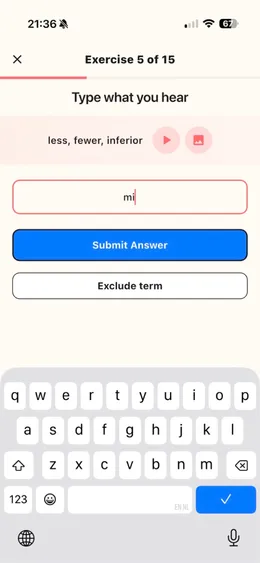
PolyYapp schedules words on a custom 14-level ladder. A correct answer moves a word up one level; a wrong answer moves it down one level, never back to the start. A lesson holds up to 15 exercises across 5 exercise types: translation choice, reverse choice, listening (you type the word you hear), word scramble and fill in the blanks. The harder types unlock for each word as you answer it correctly, so you recognise a word before you are asked to spell it. The exercises hub describes each type.
The trade-off runs both ways. Babbel teaches each word in a sentence and a situation, which PolyYapp’s word-first approach does not; PolyYapp shows example sentences only inside its scramble and fill-in exercises. PolyYapp, on the other hand, picks new words at random from its list rather than by level or topic, which suits someone filling gaps around a course and suits a true beginner less well.
Can you add your own words to Babbel or PolyYapp?
PolyYapp lets you build your own review list. Any learner can search its dictionary (by Dutch spelling, not by meaning) and add a word, and after Sign in with Apple you can create up to 10 new words a day that the dictionary lacks: a word from a letter from the gemeente, from work or from a Babbel lesson. Those words then come back on the same spaced-repetition schedule. The your own words hub shows how.
For Babbel, every description of Personalized Review found for this comparison treats it as a review of course content, and no feature for adding your own Dutch words turned up. That was not confirmed by using the app, so treat it as unverified rather than as a missing feature.
Is Babbel free, and is PolyYapp?
Babbel is free only as a sample; PolyYapp is free today. Babbel’s Dutch page offers the first lesson free, with no credit card required, and full courses need a subscription after that. The App Store listing names plans of several lengths and a lifetime option, sold per language or as an all-languages plan, and subscriptions renew automatically. There is no ongoing free tier for practising.
PolyYapp is free to download and use, with no in-app purchases and no ads today. Its privacy policy reserves the right to add in-app purchases later, so free is a description of now, not a promise. The two models suit different people: Babbel’s subscription pays for a written course and recorded audio that a free word trainer does not have.
Which languages can you learn Dutch from?
PolyYapp shows the interface and every Dutch meaning in one of 7 languages: English, Spanish, French, Polish, Russian, Turkish and Ukrainian. A Ukrainian speaker sees Ukrainian meanings, with no English in between. The learn in your language hub covers how that setting works.
Babbel’s Dutch course is confirmed from English, German and French, from Babbel’s own localised Dutch pages. Other display languages Babbel offers are unverified for Dutch, and no evidence was found that Dutch can be learned from Russian, Ukrainian, Turkish or Polish. For a German speaker Babbel is a natural fit, while learners who would rather work from Polish, Russian, Turkish or Ukrainian are better served by PolyYapp’s word meanings.
Does Babbel or PolyYapp need an account?
PolyYapp needs no account; Babbel effectively does. PolyYapp’s first launch creates an anonymous profile on the server, and Sign in with Apple is optional, needed only to create new custom words, for the Profile screen and to delete the account in the app. There are no ads and no analytics SDKs in the app; progress is stored on PolyYapp’s server so it can follow you.
For Babbel, third-party guides say an account is required to save progress and use the review manager. Its App Store privacy label (read 2026-10-31) declares Purchases, Identifiers and Usage Data as data used to track you, and Contact Info, Purchases, User Content (including audio), Identifiers and Usage Data as linked to you. A label is the developer’s own declaration. PolyYapp’s label also lists data types linked to you, so read both before deciding on privacy grounds.
Can you use Babbel and PolyYapp together?
Yes. Babbel gives the structure: grammar in order, dialogues, pronunciation feedback and a path from A1 to around B1. PolyYapp gives volume and repetition: a short daily session that keeps a growing word list from slipping, including words from outside the course, such as a letter from the gemeente.
A workable routine is a Babbel lesson for new grammar, then a PolyYapp session the same day. When a Babbel dialogue uses a word you keep forgetting, search for it in PolyYapp and add it, so it joins the review queue. The cost of this pairing is a Babbel subscription plus the time for both, and it only works on an iPhone, iPad or Apple-silicon Mac, since PolyYapp has no Android version.
When should you pick Babbel instead of PolyYapp?
Pick Babbel when you want to be taught Dutch from zero, not just drill words. If you need grammar explained in order, dialogues to copy, speech-recognition feedback on pronunciation and a clear path from A1 to B1, Babbel is a complete course and PolyYapp is not. Babbel is also the better choice if you need to study offline, since PolyYapp needs a connection. On an Android phone or in a browser, Babbel is the only option of the two.
Pick PolyYapp when the course is already handled and the words are the problem, when you would rather learn Dutch from Polish, Russian, Turkish or Ukrainian, or when you want to practise vocabulary without an account or a subscription. Many learners use both. If you are weighing more than these two apps, the best apps to learn Dutch compares seven of them, PolyYapp vs Duolingo covers the free course option, and Duolingo alternatives for Dutch splits the field by what you are missing. For the exam, the best apps for inburgering sets out which exam parts each app covers.
What this comparison could not confirm
Several Babbel details rest on sources that could not be checked directly. The full list of languages its Dutch course is taught from is unconfirmed beyond English, German and French. Whether the course adds topics at B2 comes from a search snippet of a support page that returned an error. Babbel’s claim of more than 500 Dutch lessons is vendor marketing that was not counted. Whether Babbel Speak and live classes cover Dutch, whether any feature for adding your own words exists, and whether an account is strictly required before the free first lesson are all open. Each is stated on this page only as far as the evidence goes.
Questions
Is PolyYapp or Babbel better for learning Dutch?
Babbel, if you need to be taught Dutch from zero: it is a complete course with grammar, dialogues, speech recognition and levels from A1 to around B1. PolyYapp is better at one narrower job, building and keeping a large Dutch vocabulary with spaced repetition, and it is free today. PolyYapp is not a course and has no grammar lessons, so it cannot replace Babbel on its own.
Can PolyYapp replace Babbel?
No. PolyYapp is a vocabulary trainer: it has no grammar lessons, no speaking practice, no dialogues and no course levels. It teaches Dutch words with spaced repetition and 5 exercise types. If you drop Babbel, you need a teacher, a class or another course for grammar and speaking, and PolyYapp can sit next to that.
Does Babbel's Dutch course go beyond B1?
Not as far as could be confirmed. Babbel's own Dutch level page splits the course into A1, A2 and B1. A search snippet of Babbel's support page mentions additional Dutch topics up to B2, but that page could not be opened to check. Either way, advanced learners run out of course. PolyYapp has no levels at all: it is a vocabulary trainer, not a course.
Does PolyYapp teach words by level or topic?
No. PolyYapp mixes words that are due for review with new words picked at random from about 3,900 curated Dutch words, not by level, topic or frequency. You can steer it by searching its dictionary for a word you met and adding it, or, after Sign in with Apple, by creating a word it lacks. Babbel works the other way, introducing words inside lessons in course order.
Can I learn Dutch from Ukrainian or Russian with Babbel?
Not as far as this comparison found. Babbel's Dutch course is confirmed from English, German and French, and no evidence turned up that it is taught from Ukrainian, Russian, Turkish or Polish, though Babbel's full list for Dutch is unconfirmed. PolyYapp shows its interface and every Dutch meaning in Ukrainian or Russian, as well as English, Spanish, French, Polish and Turkish.
Which is better for inburgering, Babbel or PolyYapp?
Neither is an exam course, and neither has an exam mode. Practice exams exist at A2, B1 and B2, and inburgeren.nl links to them; working through those is the closest practice to the real exams. Babbel adds grammar and speaking practice up to around B1. PolyYapp builds only vocabulary, which underpins every exam part, Reading and Listening most directly, and it does not cover Knowledge of Dutch Society. This site's best apps for inburgering page compares more options.