
PolyYapp vs Duolingo: Course or Vocabulary Trainer
Short answer
PolyYapp and Duolingo do different jobs. Duolingo is a free, ad-supported, game-like course that teaches Dutch grammar, sentences and speaking from zero, on iPhone, Android and the web. PolyYapp is a vocabulary trainer for iPhone, iPad and Apple-silicon Macs: it schedules each Dutch word on a visible spaced-repetition ladder, lets you add your own words and shows meanings in 7 languages, but it has no grammar lessons and no speaking practice. From zero, start with Duolingo; if you already have a course or class and need words to stick, PolyYapp is the vocabulary layer.
Key points
- Duolingo wins on everything a course needs: grammar and sentence-building from zero, speaking and writing exercises, and a fixed path that decides what comes next.
- Duolingo also wins on reach: iPhone, iPad, Android and the web with synced progress, against PolyYapp's Apple-only apps that need an internet connection.
- A third-party course tracker (snapshot 8 July 2025) labels Duolingo's Dutch course A2, against B2 for its Spanish, French and German courses.
- PolyYapp shows when each Dutch word is next due and lets you reset or ignore it; Duolingo's review scheduling is internal, and no per-word due dates were found.
- PolyYapp lets you search its dictionary and create your own Dutch words; no way to add words from outside Duolingo's course was found (checked 31 October 2026).
- The same tracker lists Dutch on Duolingo as taught from English only; PolyYapp shows meanings in English, Spanish, French, Polish, Russian, Turkish or Ukrainian.
Duolingo’s facts on this page come from its US App Store listing, its own blog, the DuolingoData course tracker and Apple’s public review feed, all read on 31 October 2026; PolyYapp’s come from its source code. None of the roughly 450 recent Duolingo reviews sampled mentioned Dutch, so the review complaints below are general ones, not complaints about the Dutch course.
Is PolyYapp or Duolingo better for learning Dutch?
Duolingo is the better first app for learning Dutch from zero; PolyYapp is better at one narrower job, making Dutch words stick. Duolingo is a course: it decides what you learn and in what order, and teaches Dutch grammar, sentences, listening and speaking alongside vocabulary. PolyYapp is a vocabulary trainer: it treats the Dutch word as the unit, brings each word back just before you are likely to forget it, and leaves grammar to something else.
So the answer depends on what you are missing. A complete beginner needs a course first, and Duolingo is the free, low-friction one. Someone who already has a course, a class or a teacher and keeps blanking on everyday words is the person PolyYapp is built for. On an iPhone, the two fit together without overlapping much.
Duolingo wins on grammar, speaking and breadth of skills; PolyYapp wins on seeing and steering the review schedule, adding your own words, and studying from a language other than English.
| App | What it teaches | Grammar and speaking | Your own words | How reviews are scheduled | Meanings shown in |
|---|---|---|---|---|---|
| Duolingo | A fixed-path, game-like Dutch course, one of more than 40 language courses in the app | Grammar and sentence-building from zero; speaking, reading, listening and writing exercises in lessons | No way to add words from outside the course was found | Internal; Duolingo has published research on its spaced-repetition model, but due dates are not shown per word | English only, per the DuolingoData tracker (not checked in the in-app course picker) |
| PolyYapp | Dutch vocabulary only, from about 3,900 curated words (as of October 2026), with 5 exercise types | No grammar lessons and no speaking practice; word cards show de or het on nouns, and plural, diminutive and verb forms where the data has them | Dictionary search for any user; creating a new word needs Sign in with Apple, up to 10 a day | A visible 14-level ladder; each word shows when it is next due, and can be reset or ignored | Any of 7: English, Spanish, French, Polish, Russian, Turkish, Ukrainian |
What does Duolingo teach that PolyYapp does not?
Duolingo teaches Dutch as a course, and that is the biggest difference between the two apps. Its App Store listing describes game-like lessons that build speaking, reading, listening and writing, and the Dutch course introduces grammar and sentence-building step by step alongside the words. PolyYapp teaches none of that: it has no grammar lessons, no sentence-building course and no speaking practice.
Neither app takes a learner far past beginner level, for different reasons. Duolingo’s Dutch course stops at the level the third-party DuolingoData tracker labels A2 (snapshot of 8 July 2025); the Duolingo alternatives page breaks that course down section by section. PolyYapp has no levels at all, so it never runs out of course, but it also never moves you on to harder grammar.
Per a Duolingo blog post of 14 January 2026, Video Call with Falstaff, an AI conversation feature, is offered to Duolingo Max subscribers learning nine languages on iOS, and Dutch is not among them. PolyYapp has no conversation feature of any kind.
How do Duolingo and PolyYapp schedule Dutch word reviews?
PolyYapp shows you the schedule; Duolingo keeps it inside the course. PolyYapp puts every Dutch word on its own 14-level spaced-repetition ladder. A lesson of up to 15 exercises is filled first with the words that are due, oldest first, and only then topped up with new ones. A correct answer moves a word up one level; a wrong answer moves it down one level, not back to the start.
In PolyYapp’s My Words list, each word carries a progress bar for its level and a line such as “due now” or “review in 3 days”. From there you can reset a word, move it to Ignored so it stops appearing, or restore it later. There are no settings for the intervals themselves, and new words arrive at random from the curated list rather than by topic or level.
Duolingo does use spaced repetition: its researchers published a half-life regression model for predicting forgetting at ACL 2016, and the Dutch course has a Daily Refresh section. No per-word due date was found in Duolingo, and words arrive in Duolingo’s order, inside Duolingo’s sentences. The guide to learning Dutch words covers spaced repetition as a method, whichever app runs it.
Can you add your own words to Duolingo or PolyYapp?
PolyYapp lets you, and no equivalent was found in Duolingo. In PolyYapp, the Add Word screen searches the Dutch dictionary as you type, and any result can go onto your list in a tap, with no account. If a word is missing, a signed-in user can create it: PolyYapp checks that it is real Dutch, finds its dictionary form, and generates its meanings and grammar. The cap is 10 new words a day, and creating them needs Sign in with Apple.
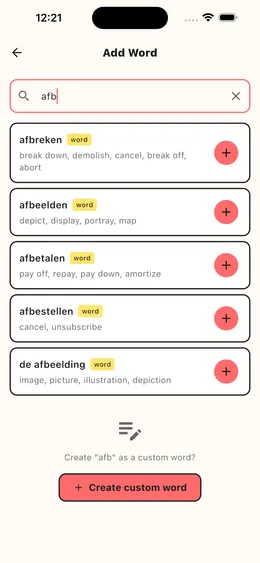
Duolingo’s vocabulary is the course’s vocabulary. No feature for adding a word you heard at work, read in a letter from the gemeente or saw on a sign was found, so those words get practised only if the course happens to teach them. PolyYapp’s search matches Dutch text only, so you look up “huis”, not “house”.
Which languages can you learn Dutch from in PolyYapp and Duolingo?
PolyYapp offers 7, Duolingo apparently one. PolyYapp’s app languages are English, Spanish, French, Polish, Russian, Turkish and Ukrainian, and one language setting drives both the interface and the language Dutch meanings are shown in, so a Turkish speaker sees Turkish meanings with no English in between. Duolingo’s only Dutch course in the DuolingoData tracker is the one for English speakers, which puts a Polish or Ukrainian speaker on an English route into Dutch. The in-app course picker was not checked. Those meanings are generated with AI per sense and cached, and the word card adds register tags such as informal or formal.
What do Duolingo and PolyYapp exercises look like?
Duolingo’s exercises serve the course: you translate sentences, match pairs, listen and speak, inside lessons that follow one path for everyone. PolyYapp’s 5 exercise types serve the single word: translation choice, reverse choice, listening, word scramble and fill in the blanks. Every word starts on the easiest type, and the harder ones unlock for that word as you answer it correctly.
Within a PolyYapp lesson, the type for each word is picked at random, weighted towards the types you keep missing on that word. Listening asks you to type the word you hear, so spelling is part of the drill. The scramble and fill-in exercises place the word in an AI-generated Dutch sentence. Audio is text-to-speech in a Netherlands Dutch voice. Duolingo has speaking exercises in its lessons, which PolyYapp has no equivalent for.
Is Duolingo or PolyYapp free, and what does free give you?
Both can be used without paying, on different models. Duolingo is freemium: its listing states that every course is free and names Dutch among them, the free tier shows ads and rations practice with an energy system, and the Super and Max subscriptions remove ads and the energy limit or add AI features. No one-time or lifetime option was found. PolyYapp is free to download and use, with no in-app purchases and no ads today.
In US App Store reviews read on 31 October 2026, Duolingo users have reported running out of energy, seeing too many ads and being pushed towards a subscription; none of those reviews was about Dutch specifically. PolyYapp’s limits are anti-abuse caps only, but its privacy policy reserves the right to add in-app purchases, so this page does not promise it stays free. This site publishes no prices for either app.
Does Duolingo or PolyYapp work on Android and Mac?
Duolingo reaches further. It runs on iPhone, iPad, Android and the web, and progress syncs across them once you create a profile. PolyYapp runs on iPhone and iPad, and on Apple-silicon Macs as the iPad app, with no Android version and no web version. That is the clearest platform conclusion: on Android or a shared computer, Duolingo is an option and PolyYapp is not.
| App | Platforms | Internet connection | Account | Business model |
|---|---|---|---|---|
| Duolingo | iPhone, iPad, Android and the web, with synced progress | Third-party sources describe lesson downloads as a Super perk; Duolingo’s own documentation of this was not found | Duolingo’s beginner guide says to create a profile to save progress and use other devices | Freemium: free with ads and an energy limit; Super and Max subscriptions |
| PolyYapp | iPhone and iPad, and Apple-silicon Macs as the iPad app; no Android or web version | Required: lessons, words and audio all come from the server | Not needed; Sign in with Apple is optional and keeps progress tied to your Apple ID | Free today, with no in-app purchases and no ads |
PolyYapp needs no account to start: it keeps progress on its server under an anonymous ID. Duolingo’s beginner guide tells new learners to create a profile to save their progress and use other devices; it does not say whether lessons can be started before that.
When should you pick Duolingo instead?
Pick Duolingo if you are a complete beginner who wants a guided, free, game-like path from zero, including grammar and sentence-building, and you need streaks and leaderboards to keep going. It gives a structured beginner curriculum with all four skills in one app, on iPhone, Android and the web. PolyYapp does not teach grammar as a course and runs only on Apple devices.
Duolingo also wins if you are learning several languages at once and want one app for all of them, or if you want to study on a train with no signal: third-party sources say offline lessons come with the paid Super plan, and PolyYapp needs a connection. Its habit mechanics (streaks, leaderboards, reminders) are more developed than PolyYapp’s streak, activity heatmap and local reminders.
When does PolyYapp make more sense?
PolyYapp makes more sense once you have a course and the bottleneck is words. That covers a learner who finished Duolingo’s Dutch course and wants to keep growing vocabulary, a learner in a class who meets new words every week and wants them on a schedule, and anyone who would rather study Dutch from Polish, Turkish, Ukrainian, Russian, Spanish or French than through English.
It also suits people who want to see where each word stands rather than trust a hidden schedule, and who would rather not have ads or an energy limit in their study app. The trade is real: PolyYapp gives you no grammar, no speaking practice and no path through the language, so it works next to a course, not instead of one.
What this comparison could not confirm
Seven Duolingo details were not confirmed. The Dutch course’s level label and size come from the July 2025 DuolingoData snapshot, which also reports about 3,000 words taught, and may have changed since. Whether Dutch is offered from any base language other than English was not checked in the app. Free versus Super offline behaviour on iOS is documented only by third-party sources. Whether lessons can be started before creating a profile, and whether guest progress carries over into a new profile, were not tested. Whether the Practice Hub shows a word list or word-level review for Dutch was not checked. Dutch audio quality in Duolingo was not assessed.
For the wider field, the roundup of apps to learn Dutch puts both apps next to Babbel, Memrise, Clozemaster, Drops and Anki, and the Duolingo alternatives page splits the options by what Duolingo is not giving you.
Questions
Can PolyYapp replace Duolingo?
No. PolyYapp replaces only the vocabulary part of what Duolingo does. A learner who drops Duolingo for PolyYapp loses the grammar lessons, the sentence-building path and the speaking exercises, and gains a per-word review schedule, words of their own and meanings in a language other than English. A course and a vocabulary trainer do different jobs.
Should I finish Duolingo's Dutch course before starting PolyYapp?
There is no need to wait. PolyYapp has no levels and brings in new words at random from its curated Dutch word list, so it does not depend on where you are in Duolingo's path. Running both from the start lets you look up a word from a Duolingo lesson in PolyYapp's dictionary and add it to your reviews. Learners who have already finished Duolingo's Dutch course can use PolyYapp to keep adding vocabulary after the course ends.
Does PolyYapp have streaks like Duolingo?
Yes, in a simpler form. PolyYapp keeps a daily streak that counts lessons and the daily word game, a home-screen activity heatmap, and reminders scheduled on the device rather than pushed from a server. Duolingo's streaks, leaderboards and notifications are the more developed habit system.
Does Duolingo show de or het the way PolyYapp does?
PolyYapp prints de or het on the word card for nouns where its data has the article, next to the plural and diminutive. Duolingo teaches articles and other forms inside its lessons; no per-word card of that kind was found. Whether every Dutch noun in Duolingo's course is introduced with its article was not checked for this page.