
Best apps to learn Dutch: courses vs vocabulary trainers
Short answer
No single app teaches all of Dutch. Full courses such as Babbel (A1 to around B1) and Duolingo teach grammar, sentences and speaking; vocabulary trainers such as PolyYapp, Anki, Clozemaster and Drops make words stick. The usual answer is one of each. PolyYapp is the vocabulary layer only: a free iOS app with spaced repetition and 5 exercise types, but no grammar lessons, no speaking practice and no Android app.
Key points
- The useful split is course versus vocabulary trainer: Babbel and Duolingo teach grammar and sentences, while PolyYapp, Anki, Clozemaster and Drops drill words.
- Babbel is the most complete course of the apps compared here: grammar from A1 to around B1, speech recognition and offline lessons, on a subscription after the first free lesson.
- Duolingo's whole Dutch course is free with ads and an energy limit, but a third-party tracker labels it A2 and lists it as taught from English only.
- PolyYapp loses on grammar, speaking, Android and offline study; it is a vocabulary add-on, free today with no ads, that shows meanings in 7 languages.
- Clozemaster suits learners who already have the basics; Anki suits people who want full control and offline study; Memrise suits listening and speaking confidence.
The facts about each app on this page come from its App Store listing, its own help pages and documentation, Apple’s public review feed for some of them and, where noted, third-party trackers and guides, all read on 31 October 2026; PolyYapp’s come from its source code. None of the six other apps was used for a full course, so each row describes what the app is documented to do, not how well it does it.
What is the best app to learn Dutch?
The best app to learn Dutch depends on what you are missing, because no app on this page teaches everything. Course apps (Babbel and Duolingo, and Memrise with its scenario lessons) teach sentences and some speaking, and the first two teach grammar in order. Vocabulary trainers (PolyYapp, Anki, Clozemaster, Drops) make large numbers of words stick. The usual answer is one of each.
PolyYapp is a vocabulary trainer, and this page puts it in that column. It has no grammar lessons, no speaking practice, no exam mode and no Android app, so it cannot be anyone’s only app for learning Dutch. Where it fits is next to a course: a short daily session that brings back the words before you forget them.
What is the difference between a Dutch course app and a vocabulary trainer?
A course app decides what you learn and in what order: lessons build grammar and sentences step by step, and vocabulary comes as a by-product of each lesson. A vocabulary trainer does the opposite. It treats words as the unit, schedules each one for review just before you would forget it, and leaves grammar to something else.
The distinction matters because the two fail in opposite ways. In a course, vocabulary is a by-product of the lessons, so building a large word bank is slow, even with the review features Babbel, Duolingo and Memrise build in. A vocabulary trainer alone produces someone who knows a few thousand words and cannot build a sentence with them. In Babbel, vocabulary arrives inside lesson dialogues; PolyYapp’s App Store subtitle is “Dutch Vocabulary & Flashcards”, and words are the whole job.
How do the main Dutch learning apps compare?
The table’s conclusion: Babbel and Duolingo are the only two that teach Dutch grammar as a course, PolyYapp is the only one with no Android version, and PolyYapp’s advantages are narrow ones (meanings in 7 languages, and on iOS the only one that is free with no ads, no purchases and no sign-up). Business models are described by shape; this site publishes no prices.
| App | What it is | Grammar and speaking | Your own words | Platforms | Business model |
|---|---|---|---|---|---|
| Babbel | A structured Dutch course in A1, A2 and B1 levels, with dialogues and review of lesson vocabulary | Grammar taught in order; speech recognition for pronunciation; native-speaker audio per Babbel’s Dutch page | No feature for adding your own words was found (unverified) | iPhone, iPad, Android, web; lessons can be downloaded for offline study | Subscription; the first lesson of each course is free |
| Duolingo | A fixed-path, game-like Dutch course among more than 40 languages | Grammar and sentence-building from zero to roughly A2 (third-party tracker); speaking exercises in lessons | None; vocabulary comes from the course | iPhone, iPad, Android, web | Freemium: whole course free with ads and an energy limit; Super and Max subscriptions |
| Memrise | Scenario lessons with native-speaker video and AI conversation partners | No grammar course; speaking practice with AI partners | None; the course decides the vocabulary | iPhone, iPad, Android, web | Freemium with ads; Pro subscription unlocks all lessons, videos and conversations |
| Clozemaster | Fill-in-the-blank Dutch sentences ordered by word frequency, aimed at A2 to C1 | Grammar collections (articles, modal verbs, prepositions) but no course; a Speaking mode; not for complete beginners | Custom sentence collections on Pro only | iPhone, iPad, Android, web | Freemium with a daily sentence cap; Pro subscription adds offline downloads |
| Drops | Picture-first vocabulary micro-games in short sessions, across more than 55 languages | None: no grammar, sentences or conversation | No way to add your own words was found | iPhone, iPad, Android; offline on Premium | Freemium with a time-capped free tier and ads; Premium subscription |
| Anki (AnkiMobile on iOS) | A general spaced-repetition engine with no Dutch content of its own; community decks on AnkiWeb | None built in; only what a deck author adds | Yes, any card you build | iPhone, iPad, Android, Windows, macOS, Linux, web; fully offline | Free on desktop and Android; one-time paid purchase on iOS; no subscription, no ads |
| PolyYapp | A Dutch-only vocabulary trainer with spaced repetition and 5 exercise types | No grammar lessons and no speaking practice; word cards show de/het, plurals and verb forms | Yes, after Sign in with Apple, up to 10 new words a day | iPhone and iPad, and Apple-silicon Macs as the iPad app; no Android; needs an internet connection | Free today, with no in-app purchases and no ads |
Which apps teach Dutch as a full course?
Babbel and Duolingo are the two apps on this page that teach Dutch as a course, with grammar introduced in order. Memrise teaches through real-life scenarios and video rather than a grammar sequence. If you are starting from zero, one of these comes first, and a vocabulary trainer comes second.
Babbel is the most complete course here. Its Dutch course runs from A1 to around B1 with grammar, dialogues, listening and speaking, uses audio recorded by native Dutch speakers according to Babbel’s Dutch page, and adds speech recognition and downloadable lessons. The catch is the model: after the first free lesson there is no ongoing free tier, an account is effectively required, and Dutch is confirmed only from English, German and French. Pick Babbel when you want to be taught Dutch from zero, not just drill words.
Duolingo is the free, low-friction start. The whole Dutch course is reachable without paying, with ads and an energy system, and its streaks and leaderboards are built for showing up every day. The DuolingoData course tracker, in its July 2025 snapshot, labels the Dutch course A2, against B2 for Spanish, French and German, and lists it as taught from English only. Users have reported frustration with the energy limit and with ads (App Store reviews read 2026-10-31). Pick Duolingo if you are a complete beginner who wants a guided, game-like path, on any platform, and see Duolingo alternatives for Dutch for what to add once its course runs out.
Memrise is for listening and speaking confidence. Its Dutch course is built on native-speaker video clips and an AI conversation partner, with a documented spaced-repetition ladder for the course vocabulary. The free plan limits lessons and videos and shows ads, and users have reported heavy paywalling (App Store reviews read 2026-10-31). Pick Memrise if hearing real Dutch speakers and practising out loud matter more to you than grammar explanations.
Which apps train Dutch vocabulary?
PolyYapp, Anki, Clozemaster and Drops are vocabulary trainers: they make words stick and leave grammar to a course. They differ most in who picks the words and how hard the exercises ask you to work, which is the axis the vocabulary-app roundup covers in depth.
Clozemaster teaches each word inside a real Dutch sentence, ordered by how common the missing word is, and goes far into the long tail. Its own description aims it at A2 to C1 and says it is not for complete beginners. Pick it once you know the basics and want thousands of sentences.
Anki is the most configurable option: you choose or build every card, study fully offline, and sync across desktop, Android and iOS. It ships no Dutch content, users have reported shared decks full of mistakes (App Store reviews read 2026-10-31), and AnkiMobile is a paid purchase on iOS. Pick it if you want full control and one tool for everything you study.
Drops turns words into illustrated micro-games of a few minutes. It teaches words without sentences or grammar, and its free tier is time-capped with ads. Pick it if pictures and a light daily game keep you going.
Where does PolyYapp fit, and where does it lose?
PolyYapp is the vocabulary layer for someone already following a course, on an iPhone or iPad. It teaches Dutch words with spaced repetition (a custom 14-level review ladder where a wrong answer drops a word one level, not back to the start) and 5 exercise types, from about 3,900 curated Dutch words as of October 2026. Audio is text-to-speech in a Netherlands Dutch voice.
Two things set it apart from the others here. PolyYapp shows meanings in English, Spanish, French, Polish, Russian, Turkish or Ukrainian, so a Turkish or Ukrainian speaker learns Dutch without going through English. Its word card shows de or het, plurals, diminutives and verb forms, and marks separable verbs. Among the iOS versions of these apps, it is also the only one that is free with no ads, no in-app purchases and no sign-up today: Duolingo also starts without an account, and Anki has no ads but is a paid purchase on iOS.
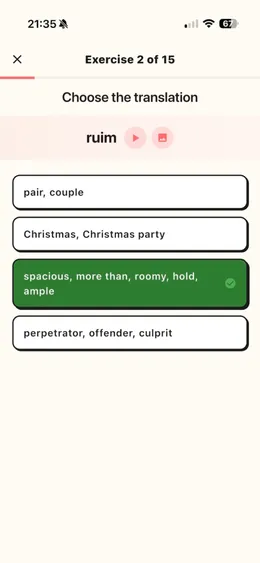
PolyYapp loses on the rows a course wins. It has no grammar lessons, no speaking practice and no exam mode. It has no Android or web version, it needs an internet connection, and its new words come at random from the curated list rather than in frequency order or by level. If any of those is your main need, one of the other six apps is the better choice, and the PolyYapp vs Babbel and PolyYapp vs Duolingo pages go through them row by row.
Which combination of apps suits which learner?
The best app to learn Dutch is usually a pair: one course or practice tool for structure and speaking, and one vocabulary trainer for words. The table matches common situations to a pairing; every row has a catch, and PolyYapp is not part of every pairing.
| If you are… | A pairing that fits | The catch |
|---|---|---|
| A complete beginner who wants to start free | Duolingo for the course, plus PolyYapp or Anki for vocabulary | Duolingo’s Dutch course is labelled A2 by a third-party tracker, so you will need something more after it; Anki is free on desktop and Android but a paid purchase on iOS |
| Someone who wants grammar explained in order | Babbel for the course, plus PolyYapp or Anki for vocabulary | Babbel needs a paid plan after the first lesson |
| Past the basics (around A2) and wanting more words in context | Clozemaster, plus a teacher or class for speaking | Clozemaster’s free daily cap is enough for a taste; an account is required |
| Most concerned with listening and speaking confidence | Memrise for video and AI conversation, plus a teacher or conversation partner | Memrise’s free plan limits lessons and shows ads |
| On Android or a desktop | Anki with a Dutch shared deck, plus Babbel or Duolingo | PolyYapp is not available to you; check any shared deck for errors |
| Needing to study offline | Anki with a Dutch shared deck, plus Babbel (downloadable lessons) | PolyYapp needs a connection; Duolingo’s offline lessons are reported only by third parties, on the paid Super plan |
| Learning from Polish, Russian, Turkish, Ukrainian or Spanish | PolyYapp for vocabulary in your own language, plus a course or teacher | Duolingo’s Dutch course is English-based per the tracker, and Babbel’s is confirmed only from English, German and French |
| Preparing for inburgering | A course or teacher, DUO’s free practice exams, plus a vocabulary trainer for the words the Reading and Listening exams test | No app here has an exam mode or a KNM course |
| Motivated by pictures and short games | Drops, plus a course for sentences and grammar | Drops’ free tier is time-capped, with ads |
For inburgering, DUO’s free practice exams (at A2 under the 2013 act, and for the B1 and B2 state exam used on the 2021 act’s B1 route, per inburgeren.nl, Practicing for the exam, read 2026-10-31) matter more than any app; which level applies to you, the inburgering app roundup and the inburgering hub cover the rest.
Can one app teach you Dutch on its own?
No app on this page takes an adult to fluent Dutch on its own. Babbel comes closest as a course, and it stops around B1. Duolingo’s Dutch course stops earlier. Vocabulary trainers, PolyYapp included, teach none of the grammar or speaking that real conversations and exams test.
Time matters more than the choice of app. Exam providers estimate about 350 to 400 guided hours to reach B1 in English or French, the nearest figures available for Dutch, and how long it takes to learn Dutch sets out those figures and where they come from. An app is one part of those hours, usually the part you can fit into ten minutes on the train. If cost is the deciding factor, free apps to learn Dutch looks at what each free tier really gives you.
Questions
Which Dutch learning app is best for a complete beginner?
A course app, because a complete beginner needs grammar and sentences before a word list is much use. Babbel teaches Dutch grammar in order from A1 but needs a paid plan after the first lesson; Duolingo's whole Dutch course is free with ads and an energy limit. Clozemaster says it is not for complete beginners. Add a vocabulary trainer such as PolyYapp (iPhone and iPad) or Anki alongside the course.
Should I start with a course app or a vocabulary app?
Start with a course app if you are starting from zero: a vocabulary trainer teaches words but not how to build sentences with them. Add a vocabulary trainer when you want more words than the course gives you. If a class or a teacher already covers grammar and speaking, a vocabulary trainer such as PolyYapp, Anki or Drops can be the only app you need.
Is Babbel or Duolingo better for learning Dutch?
Babbel is the more complete course: grammar taught in order from A1 to around B1, native-speaker audio, speech recognition and downloadable lessons, but it needs a paid plan after the first lesson. Duolingo is free with ads and an energy limit and is better at keeping a daily habit, but its Dutch course is shorter. Both run on phones and the web.
Is Memrise good for learning Dutch?
Memrise is good for listening and speaking confidence: its Dutch course is built on native-speaker video clips and AI conversation partners, with a documented spaced-repetition ladder for course vocabulary. It has no grammar course, its free plan limits lessons and videos and shows ads, and no offline mode is documented.
Which Dutch learning app works on Android?
Duolingo, Babbel, Memrise, Clozemaster, Drops and Anki (as AnkiDroid) all run on Android. PolyYapp does not: it runs on iPhone and iPad, and on Apple-silicon Macs as the iPad app. Android users who want a spaced-repetition trainer for Dutch words can use Anki with a shared deck, or Clozemaster once they know the basics.