
Duolingo Alternatives for Dutch, by What You Are Missing
Short answer
Which Duolingo alternative for Dutch fits depends on what the course is not giving you. For grammar taught in order up to around B1, Babbel. For speaking out loud, Memrise's AI conversation partners or Babbel's speech recognition. For depth past A2, Clozemaster's frequency-ordered sentences. For making words stick, PolyYapp, a free vocabulary trainer for Apple devices with visible spaced repetition and meanings in 7 languages; it has no grammar lessons and no speaking practice. You can also keep Duolingo and add a narrower app for one gap.
Key points
- A third-party tracker (DuolingoData, snapshot of 8 July 2025) labels Duolingo's Dutch course A2 and lists it as taught from English only. That explains two common reasons to look elsewhere: depth and source language.
- For grammar explained in sequence and a course that continues to around B1, Babbel is the closest replacement, on a subscription after the free first lesson. It repeats Duolingo's beginner levels, so it is a switch rather than an add-on.
- For speaking, Memrise has AI conversation partners and native-speaker video, and Babbel has speech recognition. Duolingo's January 2026 language list for Video Call with Falstaff, its guided AI conversation feature, leaves out Dutch.
- For vocabulary retention, PolyYapp shows when each word is next due and lets signed-in users add their own words; Anki gives full control and offline study, at the cost of building or vetting your own decks.
- PolyYapp is not a course: it has no grammar lessons and no speaking practice, runs only on Apple devices, and needs an internet connection.
- Complete beginners who want a free, guided path from zero are better served by staying with Duolingo, and PolyYapp is not an option for anyone who needs Android or the web.
Competitor facts on this page come from each app’s US App Store listing, its own website and help pages, Duolingo’s blog and the DuolingoData course tracker, all read on 31 October 2026; PolyYapp’s come from its source code. None of the roughly 450 recent Duolingo reviews sampled mentioned Dutch, so the review complaints below are general ones, not complaints about the Dutch course.
Which Duolingo alternative for Dutch do you need?
For grammar and structure, the Duolingo alternative for Dutch is Babbel; for speaking, Memrise; for depth past A2, Clozemaster; for vocabulary retention, PolyYapp or Anki; and Drops is the lighter vocabulary option. None of them replaces the whole of Duolingo for free.
Start from what Duolingo is not giving you, not from a ranking. Duolingo’s Dutch course is a free, game-like beginner path with grammar, listening and speaking in one app. People look for a Duolingo alternative for Dutch when they hit one of five gaps: the course runs out, they want grammar explained in sequence, the words do not stick, there is no conversation practice (Duolingo’s Video Call with Falstaff does not cover Dutch), or English is not their language. Each gap points to a different app, and each of those apps gives up something Duolingo has.
| App | The gap it fills | What you give up compared with Duolingo | Free path | Platforms |
|---|---|---|---|---|
| Babbel | Grammar taught in order, dialogues and speech-recognition pronunciation practice, in a Dutch course split into A1, A2 and B1 | No ongoing free tier: after the first lesson each course needs a paid subscription, and an account is effectively required | The first lesson of each course only | iPhone, iPad, Android and the web |
| Memrise | Speaking: AI conversation partners and native-speaker video clips, in real-life scenarios | Free access: users have reported most lessons locked behind the Pro subscription, where Duolingo’s whole Dutch course is free, and an account appears to be required, where Duolingo lets you start without one | Limited vocabulary lessons, videos and conversations, with ads | iPhone, iPad, Android and the web |
| Clozemaster | Depth: Dutch fill-in-the-blank sentences ordered by how common the missing word is, aimed at A2 to C1, plus grammar collections | No beginner path: by its own description it is not for complete beginners, and listening practice is a Pro feature | A capped number of sentences a day, and an account is required | iPhone, iPad, Android and the web |
| Anki | Retention with total control: the most configurable scheduler, cards of any kind, fully offline study | No ready-made content: Anki ships no Dutch, so you build cards or vet community decks yourself | Free on desktop, Android and the web; AnkiMobile on iPhone and iPad is a one-time purchase | iPhone, iPad, Windows, macOS, Linux, Android and the web |
| Drops | A lighter vocabulary habit: illustrated words and tap-and-swipe games in sessions of a few minutes | No sentences or grammar, and little typed recall: most exercises are tapping and swiping, and no exercise where you type a word from audio was found | A short, time-capped daily session with ads | iPhone, iPad and Android |
| PolyYapp | Retention for Dutch specifically: about 3,900 curated Dutch words (as of October 2026) on a visible 14-level review ladder, 5 exercise types, your own words (creating new ones needs Sign in with Apple), and meanings in 7 languages | Almost everything a course does: there are no grammar lessons and no speaking practice, it runs on Apple devices only, and it needs an internet connection | Free, with no in-app purchases and no ads today; no account needed to start | iPhone, iPad, and Apple-silicon Macs as the iPad app |
How far does Duolingo’s Dutch course go?
Duolingo’s Dutch course is a beginner course, and it ends sooner than its courses for the big languages. The DuolingoData tracker’s Dutch-from-English page (snapshot of 8 July 2025) lists 123 units in four sections: an introduction, two sections labelled A1 and a final section labelled A2. The tracker’s index labels the Dutch course A2 as a whole, against B2 for Spanish, French and German from English. Those labels are the tracker’s, not Duolingo’s.
If you have finished the Dutch course and want more, two apps go further. Babbel’s Dutch course is split into A1, A2 and B1, so it overlaps Duolingo at the start and continues one level past it; it tops out around B1, so advanced learners run out of material there too. Clozemaster is aimed at A2 to C1 and works through real Dutch sentences ordered by how common the missing word is, from the most common hundred words out into the long tail. Pick Clozemaster if you know the basics and want thousands of sentences in context. Its free account plays a capped number a day.
PolyYapp is not an answer to this gap. PolyYapp has no levels and no course to follow, and new words come at random from its word list rather than by difficulty.
Which app explains Dutch grammar better than Duolingo?
Babbel is the closest match for grammar. Its Dutch pages describe short lessons built around everyday dialogues, such as ordering food or asking directions, with grammar, listening, speaking and culture taught together. It includes Personalized Review, which applies spaced repetition to the words and phrases met in lessons. The trade-off is the business model: the first lesson of each course is free, and after that Babbel needs a paid subscription and, in practice, an account. Pick Babbel when you want to be taught Dutch from zero, not just drill words. The PolyYapp vs Babbel comparison covers that split in detail.
Clozemaster takes a different route: it drills grammar rather than teaching it from scratch. Its Dutch collections include articles, modal verbs, prepositions, pronominal adverbs and adjective inflection, and an Explain option gives grammar notes after a wrong answer. That suits someone who already knows the rules and keeps getting de and het, or erop and daarmee, wrong.
PolyYapp has no grammar lessons. What PolyYapp does show is grammar as reference on each word card, where the data has it: de or het on nouns, the plural and diminutive, the past simple and past participle, and a flag on separable verbs. That helps you learn a noun together with its article, but it does not teach you how a Dutch sentence is built.
What helps Dutch vocabulary stick better than Duolingo?
Spaced repetition that you control, with room for the words you actually meet, helps Dutch vocabulary stick better than Duolingo does. Duolingo has published research on its review model, but the scheduling stays inside the course, and the words you review are the course’s words. Vocabulary from your job, your post or the street comes up only when a lesson covers it. Anki and PolyYapp answer that gap in different ways.
Anki gives the most control. It offers two schedulers, the legacy SM-2 and the opt-in FSRS, with intervals, limits and learning steps all adjustable, and cards of any kind, studied fully offline. Anki ships no Dutch content, so you build cards or download community decks, and users have reported shared decks full of mistakes. Pick Anki if you are a disciplined, self-directed learner who already uses it or wants one tool for everything you study.
PolyYapp gives you ready-made Dutch with less setup. It starts from about 3,900 curated Dutch words on a 14-level review ladder, shows in My Words when each word is next due, and lets signed-in users add words that are not in the dictionary, up to 10 a day. Its 5 exercise types run from picking a meaning to typing a word into a sentence. The spaced repetition hub and the exercises hub describe the mechanics.
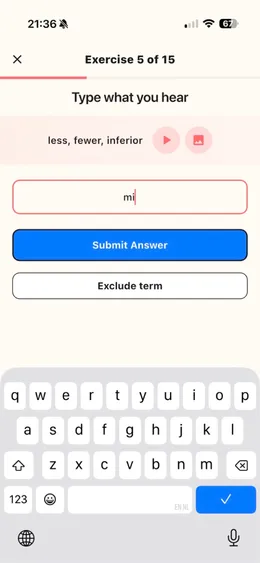
Drops suits a lighter habit: each word arrives as an illustration, followed by tap-and-swipe games in sessions of a few minutes, and its free tier is a short, time-capped session with ads. Memrise and Clozemaster schedule reviews too, on published ladders: Memrise’s runs from hours out to months, and Clozemaster’s out to 180 days, although one wrong answer in Clozemaster resets a sentence’s mastery to zero. The Dutch vocabulary apps roundup compares these tools by how each one picks the next word.
Which Dutch learning app lets you practise speaking?
Memrise and Babbel are the Dutch learning apps here with speaking practice, of different kinds. Memrise has AI conversation partners for speaking practice and native-speaker video clips set in real-life scenarios; its free plan limits lessons, videos and conversations and shows ads, and Pro is a subscription. Users have reported heavy paywalling, with most lessons locked behind Pro. Babbel has speech recognition for pronunciation practice and, per its Dutch page, audio recorded by native Dutch speakers. The PolyYapp vs Memrise page compares the two approaches.
Conversation practice is a gap in Duolingo for Dutch specifically. Duolingo’s lessons include speaking exercises, but a Duolingo blog post of 14 January 2026 lists Video Call with Falstaff, its guided AI conversation feature for Max subscribers on iOS, for English, Spanish, Portuguese, French, Japanese, German, Italian, Korean and Chinese. Dutch is not on that list.
PolyYapp has no speaking practice, no pronunciation scoring and no use of the microphone at all. Its audio is text-to-speech in a Netherlands Dutch voice, which helps with listening and spelling, not with speaking.
Can you learn Dutch from a language other than English?
On Duolingo, Dutch is probably taught from English only: the DuolingoData tracker lists one Dutch course, for English speakers, and the PolyYapp vs Duolingo page has the detail. Among the alternatives, Babbel teaches Dutch from English, German or French, and Clozemaster’s Dutch course is confirmed from English. PolyYapp shows Dutch meanings and its interface in any of 7 languages (English, Spanish, French, Polish, Russian, Turkish and Ukrainian), but for vocabulary only. The base languages for Memrise’s and Drops’ Dutch are undocumented, and Anki cards are in whatever language the deck author used.
Is there a Duolingo alternative for Dutch without ads or energy limits?
Yes: PolyYapp has no ads and no energy system, and Anki has no ads or subscription anywhere. Users have reported Duolingo’s energy system rationing how much they can learn on the free tier, and too many ads. PolyYapp is free with no in-app purchases and no ads today, and needs no account to start; its privacy policy reserves the right to add purchases later. Memrise and Drops have ad-supported free tiers, and Clozemaster caps free play per day. The guide to free apps for learning Dutch compares what each free tier gives you.
Which Duolingo alternatives work on Android or offline?
Babbel, Memrise and Clozemaster run on Android and the web, Drops runs on Android, and Anki runs on nearly everything. PolyYapp has no Android version; it runs on iPhone and iPad, and on Apple-silicon Macs as the iPad app, and it needs an internet connection. For study without a connection, Anki works fully offline, and Babbel’s downloadable lessons, Clozemaster Pro and Drops Premium offer offline study too.
When should you stay with Duolingo?
Stay with Duolingo if you are a complete beginner who wants a guided, free, game-like path from zero, including grammar and sentence-building, and you need streaks and leaderboards to keep going. Duolingo gives a structured beginner curriculum with all four skills in one app, on iPhone, Android and the web, and none of the alternatives here offers that combination free. It also wins if you are learning several languages at once and want one app for all of them.
You do not have to leave Duolingo to fill a gap. A narrow add-on covers one gap without being a second course: PolyYapp or Anki if words do not stick, Memrise for conversation practice, Clozemaster once you have outgrown the Dutch course. Babbel is different. It is a full course that repeats Duolingo’s A1 and A2 ground, so treat it as a switch, or as the next step to B1 after Duolingo. The PolyYapp vs Duolingo page shows how a vocabulary trainer pairs with the course, and the roundup of apps to learn Dutch covers the wider field.
Questions
Should I switch from Duolingo to Babbel or use both?
Switch, or use Babbel as the next step. Babbel's Dutch course teaches grammar, dialogues, listening and speaking across A1, A2 and B1, so its first two levels cover the same beginner ground as Duolingo's Dutch course, which a third-party tracker labels A2. Running both means paying for material you are already getting free. Babbel makes sense if you want grammar explained in sequence and accept a subscription after the free first lesson.
What should I use after finishing Duolingo's Dutch course?
Babbel's B1 level or Clozemaster. Babbel continues one level past Duolingo and tops out around B1. Clozemaster is aimed at A2 to C1 and drills real Dutch sentences ordered by how common the missing word is, so it suits learners who have outgrown a beginner course.
Is Clozemaster good after Duolingo?
For learners who know the basics, yes. Clozemaster says it is not for complete beginners and aims at A2 to C1. Its Dutch collections include grammar drills such as articles and pronominal adverbs. An account is required, a free one plays a capped number of sentences a day, listening practice is a Pro feature, and one wrong answer resets a sentence's mastery to zero.
Is Memrise a good add-on to Duolingo for Dutch speaking?
Memrise adds what Duolingo's Dutch course lacks for conversation: AI conversation partners and native-speaker video clips set in real-life scenarios. The catch is access. Its free plan limits lessons, videos and conversations and shows ads, users have reported most lessons locked behind Pro, and an account appears to be required.