
PolyYapp vs Clozemaster: Dutch Words or Sentence Cloze
Short answer
PolyYapp and Clozemaster suit different stages of learning Dutch. PolyYapp is built for beginners growing a first vocabulary: it schedules single words with spaced repetition and 5 exercise types, from about 3,900 curated Dutch words (as of October 2026), free today with no ads or in-app purchases, on iPhone, iPad and Apple-silicon Macs. Clozemaster is for learners already at A2 to C1: it blanks one word in real Dutch sentences ordered by frequency, on the web, iOS and Android, with a free daily cap and a Pro subscription.
Key points
- Clozemaster says it is not meant for complete beginners and pitches itself at A2 to C1; PolyYapp starts from your first Dutch word with no level test and no sign-up.
- PolyYapp drills one word at a time and adds sentence exercises once you know the word; Clozemaster drills a blanked word inside a full Dutch sentence from the start.
- Clozemaster wins on reach and depth: frequency collections out past 50,000 words, Dutch grammar sets, the web and Android, and offline downloads on Pro.
- PolyYapp is free today with no daily lesson cap, no ads and no in-app purchases; Clozemaster's free account plays a capped number of sentences a day, and Pro is a subscription.
- PolyYapp plays text-to-speech audio, and Clozemaster's FAQ describes its sentence audio as text-to-speech too (read 31 October 2026); unlimited listening practice is a Clozemaster Pro feature.
- PolyYapp has no grammar lessons, no speaking practice, no Android app and needs a connection; those are real reasons to pick Clozemaster or to add a course.
Clozemaster’s facts below come from its US App Store listing and privacy label, its Dutch collection pages, its Pro page, its FAQ and its community forum, all read on 31 October 2026. PolyYapp’s facts come from its code. Neither app was scored in a hands-on test, so nothing here is a measured result.
Which is better for Dutch, PolyYapp or Clozemaster?
PolyYapp vs Clozemaster is mostly a question of level. PolyYapp is a word trainer for beginners: it starts from your first Dutch word, drills it on its own, and only adds sentence exercises once you know it. Clozemaster is a sentence trainer for learners who already have the basics: it blanks one word in a real Dutch sentence and orders its collections by how common that word is. Clozemaster pitches itself at A2 to C1 and says it is not for complete beginners.
The table sets out how each app teaches. The short version: PolyYapp is easier to start and cannot go as deep, while Clozemaster goes far into the long tail and expects you to read whole sentences from the first round.
| App | Who it is for | What you practise | How the next item is chosen | Review schedule |
|---|---|---|---|---|
| PolyYapp | Beginners and anyone growing a first Dutch vocabulary; no level test at the start. | Single Dutch words through 5 exercise types, from picking a meaning to typing a word into a Dutch sentence. | Words due for review first, oldest first; free slots go to new words picked at random from about 3,900 curated Dutch words (as of October 2026). | A custom 14-level ladder; a miss moves the word down one level, never back to the start. No settings to tune. |
| Clozemaster | Learners at A2 to C1, per its App Store pitch; its Dutch page says it is not for complete beginners. | Real Dutch sentences with one word blanked, answered by multiple choice or by typing, with the translation alongside. | Collections you pick: frequency lists from the most common hundred words to past 50,000, Fast Track levels 1 to 10, and Dutch grammar sets. | Correct sentences return after 1, 10, 30 and 180 days; a wrong answer resets mastery to zero. Intervals adjustable on Pro. |
Is Clozemaster good for beginners?
Clozemaster is not built for beginners, and says so itself. Its App Store pitch names A2 to C1 as the target, and its Dutch page says it works best once you know the alphabet, pronunciation and basic grammar, so a learner on day one meets full sentences with a gap and little to hang the missing word on. The translation is shown alongside each sentence, which helps, but every round still assumes you can parse Dutch word order.
PolyYapp starts lower. There is no level test and no sign-up: the first launch shows one welcome screen and a Get Started button. Every word starts with translation choice, where PolyYapp shows the Dutch word, plays its audio and asks you to pick the meaning from four options. That is a recognition task a learner can do in the first minute, and the harder types arrive only after a word has been answered correctly.
The flip side is a ceiling: PolyYapp’s whole list is about 3,900 words (as of October 2026).
What exercises do PolyYapp and Clozemaster have?
PolyYapp has 5 exercise types that unlock per word: translation choice, reverse choice, listening, word scramble and fill in the blanks. Clozemaster has one core exercise, the cloze sentence, which it lists in Vocabulary, Listening and Speaking modes, with Flashcards and Stories added in October 2026. The difference is order: PolyYapp moves from the word to the sentence, and Clozemaster starts in the sentence.
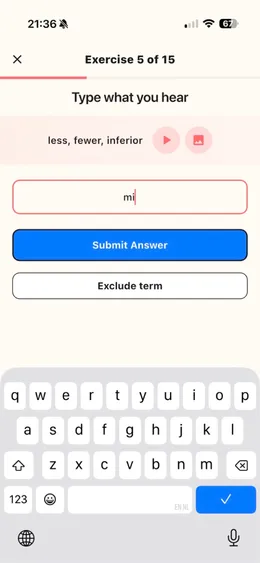
In PolyYapp, reverse choice (see the meaning, pick the Dutch word) opens after a word’s first correct answer. Listening, where you hear the word and type it in Dutch, opens after three correct translation answers. Word scramble puts the word’s letters back in order inside a Dutch example sentence, and fill in the blanks asks you to type the missing word into a sentence; both need an example sentence for that word and a few correct answers first. Within a lesson of up to 15 exercises, PolyYapp picks each word’s exercise type at random, weighted towards the types you have been getting wrong on that word.
In Clozemaster, the sentence is the lesson. Words arrive inside real sentences, so articles, word order and inflection come along with them. An “Explain” option gives grammar notes after a wrong answer, and the game layer adds points, a global leaderboard and challenges in a retro style. The exercises page has more on how PolyYapp’s types unlock.
Which app teaches the most common Dutch words first?
Clozemaster does, and PolyYapp does not. Clozemaster’s Dutch collections run from the most common hundred words through lists of 1,000, 5,000, 10,000 and 20,000 to more than 50,000, alongside Fast Track levels and grammar sets on articles, modal verbs, prepositions, pronominal adverbs, pronouns, idioms and adjective inflection. You pick the collection, and that choice decides the words you meet.
PolyYapp has no frequency bands, levels or topics to choose from. New words are drawn at random from one curated Dutch list, so two learners in their first week will likely see different words. That keeps setup at zero, but a learner who wants the top few hundred words before anything else cannot ask PolyYapp for them. The most common Dutch words guide lists the top 100 if you want a frequency list to start from.
How does each app schedule reviews?
Both apps use spaced repetition, and they punish a mistake differently. PolyYapp moves each Dutch word along a custom 14-level ladder, from three quick learning steps out to 30 days between reviews: a correct answer moves the word up one level and a miss moves it down one. Clozemaster brings a correct sentence back after 1, 10, 30 and 180 days, and one wrong answer resets that sentence’s mastery to 0%.
Clozemaster’s reset is the stricter of the two, since one miss sends a sentence back to the start. Its intervals are published, though, and Pro lets you adjust them, along with how many sentences make up a round. PolyYapp’s schedule has no settings at all, so you cannot speed it up or slow it down. In PolyYapp’s My Words list, each word shows a progress bar for its level and when it is next due. The spaced repetition page walks through the full ladder.
Is Clozemaster free, and does it need an account?
Clozemaster is freemium. Its Dutch collection pages say a free account plays up to 30 sentences a day, and Pro is a subscription sold monthly or yearly that adds unlimited play, unlimited listening practice, offline downloads, custom review intervals, advanced stats and custom collections. An account is required: its FAQ says you sign up to play. Language Innovation LLC declares on its App Store privacy label that it links Purchases, Contact Info, User Content, Identifiers, Usage Data and Diagnostics to you, with advertising or marketing among the listed purposes (label read 31 October 2026).
PolyYapp is free to download and use, with no in-app purchases and no ads today, and needs no account to start. Its only caps are anti-abuse limits, such as 10 new custom words a day. Its privacy policy reserves the right to add in-app purchases later, so “free” here describes today.
On the practical side PolyYapp loses on devices and connection: it has no Android or web version and needs the internet. It wins on the other three rows, since Clozemaster asks for an account before you play, charges a subscription for unlimited play, and has confirmed only English for showing Dutch meanings.
| App | Devices | Connection | Account | Meanings shown in | Business model |
|---|---|---|---|---|---|
| PolyYapp | iPhone and iPad, and Apple-silicon Macs as the iPad app. No Android app and no web version. | Needs an internet connection; lessons, words and audio come from its server. | None needed to start; Sign in with Apple is optional, and for learning it is needed only to create new custom words. | English, Spanish, French, Polish, Russian, Turkish, Ukrainian. | Free today, with no in-app purchases and no ads. |
| Clozemaster | iPhone, iPad, Android and the web, synced through an account. | Offline downloads of collections on Pro; word meanings work offline since version 3.22.0. | Required: its FAQ says you sign up to play. | English is confirmed for Dutch; German and French are likely but unconfirmed. | Freemium with a daily cap; Pro is a monthly or yearly subscription, with no lifetime option seen. |
Can you add your own Dutch words?
PolyYapp lets a signed-in learner add a single Dutch word, and Clozemaster’s custom content works at sentence level on Pro. In PolyYapp, after Sign in with Apple, you type a word you just met, the app checks it is real Dutch, reduces it to its dictionary form and generates its meanings and grammar, and it joins the same review queue, up to 10 new custom words a day. Anonymous users can still add any word already in the dictionary.
Clozemaster Pro users can create and share custom sentence collections, and Pro also lets you search sentences and add a word or phrase to your review queue, with automatic Google translations. For someone who meets a new word on a letter from the gemeente and wants to drill that exact word, PolyYapp is the quicker route. More on that flow is on the your own words page.
Does Clozemaster or PolyYapp use native-speaker audio?
PolyYapp does not: it plays text-to-speech audio for every Dutch word in a Netherlands Dutch voice, generated once and cached, and its listening exercise asks you to type what you hear. Clozemaster’s FAQ describes its sentence audio as text-to-speech whose quality depends on the browser, device and operating system, and its Pro page sells unlimited listening practice in more than 30 languages.
That FAQ may predate recent audio changes, since the 3.19.0 release notes mention sentence audio playing right after you answer, and whether Dutch is among the Pro listening languages was not confirmed. PolyYapp’s audio is pronunciation audio for single words, so it trains your ear on words more than on running Dutch speech.
When should you pick Clozemaster instead?
Pick Clozemaster if you are already intermediate and want words in context at scale. If you know the basics and now want to work through thousands of real Dutch sentences ordered by frequency, drill articles and pronominal adverbs (erop, daarmee), and reach the long tail beyond the most common few thousand words, Clozemaster goes deeper than PolyYapp.
It is also the better pick if you need the web or Android, want to study offline (with Pro), or, likely, want to learn Dutch from German or French. Clozemaster lists a Speaking mode, though it was not confirmed for Dutch, and PolyYapp has no speaking practice.
When is PolyYapp the better fit?
PolyYapp fits a beginner on an iPhone or iPad who wants to open an app and start, with spaced repetition already running and nothing to configure. It also fits learners who study Dutch from Polish, Russian, Turkish, Ukrainian or Spanish rather than English, since PolyYapp shows meanings in any of its 7 app languages, and anyone who wants to drill the specific words they meet in daily life.
PolyYapp is not a full course. It has no grammar lessons, no speaking practice and no exam mode, and its word card shows forms (de or het on nouns, plurals, diminutives, verb forms) without teaching the rules behind them. For the wider field, the Dutch vocabulary apps comparison sets seven apps side by side.
What this comparison could not confirm
Several Clozemaster facts rest on secondary evidence. Dutch from German and from French comes from a search snippet and public learner profiles, not a page read directly. Whether the daily cap applies to every free account is unclear, since forum users have reported that some older accounts are not capped. The quality of Dutch sentences was not assessed: users on Clozemaster’s forum have reported uneven sentence quality across language pairs (threads read 31 October 2026), but none of the threads found was about Dutch.
Sources, all read 31 October 2026: App Store listing, Dutch page, Dutch sentence lists, Pro page, FAQ and the forum threads on the daily limit and on sentence quality.
Questions
Can I use PolyYapp and Clozemaster together?
Yes, at different stages. If you are starting from zero, the order this comparison points to is a course or PolyYapp first, to build a core vocabulary one word at a time, then Clozemaster once you can read whole Dutch sentences, for words in context and the long tail of rarer words. Clozemaster's Dutch page itself says to learn the alphabet, pronunciation and basic grammar before starting (read 31 October 2026).
Where do Clozemaster's Dutch sentences come from?
Clozemaster's FAQ says its sentences and translations come from Tatoeba under a CC-BY licence, and that some of its frequency lists were built from TV and film subtitles (read 31 October 2026).
How many Dutch sentences does Clozemaster have?
Clozemaster's Dutch collection pages list counts per collection: for example 2,922 sentences in "2,000 Most Common", 1,246 in "Idioms", 997 in "Articles" and about 1,000 in each Fast Track level (read 31 October 2026). Its blog claims more than 30,000 Dutch sentences in total; that is the vendor's figure, and it was not counted here.
Does Clozemaster or PolyYapp work offline?
Clozemaster Pro lets you download collections and play them offline in the mobile app, and since version 3.22.0 word meanings also work offline. PolyYapp needs an internet connection: lessons, words and audio all come from its server, and the app cannot start without one.
Can I learn Dutch from Spanish, Polish or Russian with Clozemaster?
Not as far as this comparison could find. Clozemaster's own pages confirm its Dutch course only from English, and no evidence of Dutch from Spanish, Polish, Russian, Turkish or Ukrainian turned up (checked 31 October 2026). PolyYapp shows Dutch meanings in English, Spanish, French, Polish, Russian, Turkish or Ukrainian.