
PolyYapp vs Drops for Dutch: picture games or recall drills
Short answer
PolyYapp and Drops both teach Dutch vocabulary, in opposite styles. Drops shows each word as an illustration and drills it with tap-and-swipe games in short sessions, across more than 55 languages, with a time-capped free tier, ads and a Premium subscription. PolyYapp is a Dutch-only trainer for iPhone and iPad: spaced repetition, 5 exercise types including typing what you hear, and words you add yourself, free with no ads today. Pick Drops for pictures, Android or offline study; pick PolyYapp to recall words, see them in sentences and add your own.
Key points
- Drops wins on feel and reach: illustrated micro-games, recorded per-word audio, more than 55 languages, Android, and offline study on Premium.
- PolyYapp wins on recall: its exercises move from multiple choice to typing a word you hear and typing it into a Dutch sentence, while Drops' games are mostly tapping and swiping.
- PolyYapp lets you add the Dutch words you meet to the same review schedule; no way to add your own words was found in Drops, which offers Favorites over curated lists.
- Drops' free tier caps learning time and shows ads; PolyYapp has no time cap on lessons, no ads and no in-app purchases today.
- PolyYapp has no grammar lessons, no speaking practice, no Android app and needs a connection; Drops teaches no Dutch grammar or sentences either.
Drops’ facts on this page come from its App Store listing, its website and a FluentU review, all read on 31 October 2026. PolyYapp’s come from its source code and its App Store listing. Neither app was tested for learning outcomes, so nothing below is a measured result.
What is the difference between PolyYapp and Drops?
PolyYapp and Drops are both vocabulary apps, and they disagree about how a word gets learned. Drops introduces each word as an illustration plus the word, then reinforces it through micro-games: matching text to pictures, building words from letters, mini-crosswords. Sessions are short by design. PolyYapp schedules each Dutch word on its own spaced-repetition ladder and asks you to produce it, not only recognise it: typing a word you hear and typing it into a Dutch sentence, after multiple-choice rounds in both directions.
The other difference is scope. Drops is one engine across more than 55 languages, owned by Kahoot! since 2020. PolyYapp teaches Dutch and nothing else.
How do PolyYapp and Drops compare feature by feature?
The table’s conclusion: Drops wins on illustrations, recorded audio, the number of languages, Android and offline study, and PolyYapp wins on recall exercises, sentence practice, adding your own words, a per-word review schedule you can see and reset, and a free path with no time cap or ads. Business models are described by shape; this site publishes no prices.
| App | How a word is taught | Your own words | Audio | Platforms | Business model |
|---|---|---|---|---|---|
| Drops | An illustration plus the word, then tap-and-swipe micro-games in short sessions, organised into topic word lists; vocabulary only, with no sentences or Dutch grammar | No way to add your own words was found; you can heart words into Favorites | Per-word pronunciation by professional voice artists, per the listing; no sentence audio and no typing-from-audio exercise found | iPhone, iPad and Android; offline study on Premium; more than 55 languages | Freemium: a time-capped free tier with ads, and a Premium subscription with a free trial |
| PolyYapp | Spaced repetition on a 14-level ladder and 5 exercise types, from multiple choice to typing a word into a Dutch sentence; about 3,900 curated words (as of October 2026) | Yes: any dictionary word in a tap, and new words after Sign in with Apple, up to 10 a day | Text-to-speech in a Netherlands Dutch voice for every word, plus a listening exercise where you type what you hear | iPhone and iPad, and Apple-silicon Macs as the iPad app; no Android app; needs an internet connection; Dutch only | Free today, with no in-app purchases and no ads |
How does each app review Dutch words?
PolyYapp asks you to produce more words than Drops does, and it schedules each review. Every PolyYapp lesson of up to 15 exercises is filled first with the words due for review, oldest first, then with new words, and a correct answer moves a word up one step on its 14-level ladder, from minutes out to 30 days. A miss drops it one step, not back to the start. Harder exercise types unlock per word as you get it right.
Drops’ repetition happens mostly inside a session. FluentU’s review describes a Review Dojo that unlocks after about 50 words, with a Tough Word Dojo for hard words on Premium. Its games ask you to recognise a word more often than to produce it: the sources read for this page describe no Drops exercise where you type a word from audio. Recognition is a fine first step. The gap shows later, when you need to come up with de rekening at a till instead of picking it from four tiles.
The spaced repetition page has PolyYapp’s full schedule.
Does Drops teach Dutch words in sentences or with grammar?
Drops does not. It teaches words and short phrases, with no sentences, no conversation and no Dutch grammar. Its website announces a bigger grammar section, but the nine languages it lists do not include Dutch (checked 31 October 2026). FluentU’s review (read 31 October 2026) found few verbs in the vocabulary it covered.
PolyYapp has no grammar lessons either, so neither app will teach you word order or conjugation. What PolyYapp adds is grammar attached to each word and sentence practice. Where the data has them, its word card shows de or het on nouns, the plural and diminutive, the past simple and past participle for verbs, and a flag on separable verbs. Its word scramble and fill-in-the-blanks exercises put the word inside a Dutch sentence, generated by AI, so you see it used rather than alone. The exercises page lists all 5.
Which app uses pictures to teach words?
Drops, and it does it far more thoroughly. Every new Drops word arrives as a custom illustration plus the word, and you swipe it away if you know it or keep it to learn it. For visual learners that link between word and image, instead of word and translation, is the main reason to choose Drops, and reviewers consistently describe the sessions as enjoyable rather than a chore.
PolyYapp uses pictures only as a supporting hint. Some words have an AI-generated illustration, shown on the word card, and an AI model first decides whether a picture makes sense, so not every word has one. PolyYapp teaches through meanings in your own language and through typing, not through images.
Can you add your own Dutch words to PolyYapp or Drops?
PolyYapp, yes; Drops, as far as could be found, no. In PolyYapp you can search the Dutch dictionary and add any word to your list without an account. If a word is missing, signed-in users can create it: PolyYapp checks it is real Dutch, reduces it to its dictionary form (so “liep” becomes “lopen”) and generates its meanings and grammar. Creating new words is capped at 10 a day and needs Sign in with Apple.
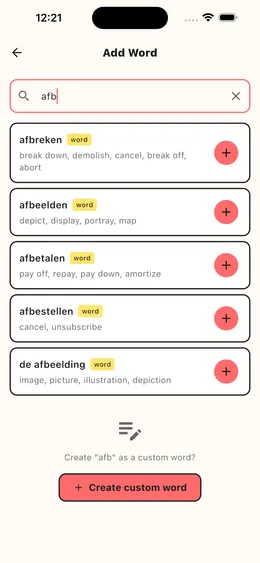
Drops is built on curated topic lists. You can heart words into Favorites to review them, but no way to enter a word of your own was found, so a word from a letter from the gemeente or a colleague’s message has nowhere to go. That is not proof the feature cannot exist, only that the listing, website and reviews read for this page do not describe one.
Words you add to PolyYapp join the same review queue as everything else. My Words then shows each word’s level and when it is next due, and you can reset, ignore or restore a word, or delete one you created. Drops lets you discard a word you know or favorite one, but no view was found that shows each word’s next review or lets you reset its progress. The your own words page walks through the flow.
How much can you study for free in Drops and PolyYapp?
PolyYapp has no time cap on lessons, no ads and no in-app purchases today. Its only daily limits are anti-abuse caps: 10 new custom words, and 10 questions and 3 hints in the Guess-a-Word daily game. PolyYapp’s privacy policy reserves the right to add in-app purchases later, so “free” describes today, not a promise.
Drops is freemium. Its free tier is a short, time-capped session with ads, and the listing marks the app as containing advertising. Sources disagree on how long the session lasts and on whether it resets once a day or after a wait of several hours, so this page gives no figure. One App Store listing says extra free time can be earned by watching ads or referring friends. Premium, a subscription with a free trial, adds unlimited learning time, all game modes, offline learning and all content, and removes ads, according to Drops’ website.
Which app has better Dutch audio?
Drops has the more natural voice per word. Its listing describes pronunciation by professional voice artists with correct dialect pronunciations. PolyYapp’s audio is text-to-speech in a Netherlands Dutch voice, generated once per word: clear and consistent, but not a person.
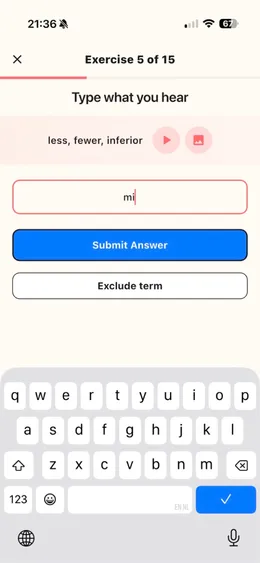
Drops’ audio covers words and phrases only, though. The sources read for this page describe no sentence audio and no listening drill. PolyYapp’s listening exercise plays a word and asks you to type it in Dutch, which trains the link between sound and spelling that Dutch vowels make hard (man and maan, bot and boot). PolyYapp has no speaking practice or pronunciation scoring, and none was found in Drops.
Which devices and languages does each app support?
Drops reaches further. It runs on iPhone, iPad and Android, teaches more than 55 languages in one app, and offers offline study on Premium. Its interface is translated into 16 languages on the App Store, though whether each can be paired with Dutch was not confirmed.
PolyYapp runs on iPhone and iPad, and on Apple-silicon Macs as the iPad app. There is no Android app, and PolyYapp needs an internet connection, because lessons, words and audio all come from its server. It teaches Dutch only, with the interface and meanings in any of 7 languages (English, Spanish, French, Polish, Russian, Turkish and Ukrainian), so a Ukrainian or Turkish speaker studies Dutch without English in between.
Do you need an account for Drops or PolyYapp?
PolyYapp needs no account and no sign-up: the first launch creates an anonymous profile and you can start a lesson straight away. Sign in with Apple is optional and is needed only to create new custom words, for the Profile screen and to delete the account in the app.
Whether Drops requires an account to start could not be confirmed. Its App Store privacy label (read 31 October 2026) declares Contact Info, Identifiers and Usage Data as used to track you. Privacy labels are self-declarations by each developer, and PolyYapp’s own label also lists data linked to you, so read both as what the developers declared rather than as an audit.
When should you pick Drops instead of PolyYapp?
Pick Drops if you learn best from pictures and games and want something light. If what keeps you going is a polished, illustrated, game-like session of a few minutes, with words tied to images rather than translations, Drops does that better than PolyYapp. It is also the better choice if you are learning several languages at once and want them in one app, if you need Android, or if you need to study offline (a Premium feature). PolyYapp runs only on Apple devices, teaches only Dutch and needs a connection.
Pick PolyYapp if you want to be made to recall Dutch words, see them in sentences, and add the words your own life throws at you, with no time cap and no ads.
Can you use PolyYapp and Drops together?
Yes. Drops can give you a few minutes of visual exposure to a new topic, and PolyYapp can carry those words into scheduled review. A word you meet in Drops can be looked up in PolyYapp’s dictionary and added in a tap if it is there; if not, signed-in users can create it (up to 10 a day). The best Dutch vocabulary apps page sets both against five other apps, and PolyYapp vs Memrise and PolyYapp vs Clozemaster cover the apps that add video and sentences.
What this page could not confirm
Drops publishes no Dutch course size, so no Dutch word count appears here. Whether a lifetime Premium option is still sold and whether a web version exists today are unverified. The standalone “Learn Dutch language - Drops” app returned no App Store lookup result in the US or the Netherlands on 31 October 2026, so only the main multi-language app is linked.
Questions
Is Drops good for learning Dutch?
Drops is good for a light, visual start on Dutch vocabulary: each word comes with an illustration and recorded audio, and the games take a few minutes. Its limits are that it teaches no Dutch grammar or sentences, most exercises are tapping and swiping, and the free tier is time-capped with ads. It works best alongside a course and a recall-based vocabulary trainer, not as the only tool.
Is PolyYapp or Drops better for learning Dutch?
It depends on how you learn. Drops is better if pictures and short games keep you going, if you need Android or offline study, or if you are learning several languages in one app. PolyYapp is better if you want to type Dutch words from memory, see them in sentences and add the words you meet yourself, with no time cap or ads today. Neither teaches grammar or speaking, so both work best next to a course.
Does Drops have a separate Dutch app?
Drops used to publish single-language apps, including "Learn Dutch language - Drops". On 31 October 2026 that app returned no result in an App Store lookup for the US or the Netherlands, so it appears to be delisted there. Dutch is taught inside the main Drops: Language Learning Games app, alongside more than 55 other languages.
How many Dutch words does Drops teach?
Drops does not publish a Dutch course size. Its App Store listing says more than 3,000 words and phrases and its website says over 5,000, both for its content overall rather than for Dutch, and older single-language listings gave a third figure. PolyYapp's curated list holds about 3,900 Dutch words, from a snapshot taken in October 2026.
Does Drops or PolyYapp work offline?
Drops does, on Premium: its website lists offline learning as a Premium feature. PolyYapp needs an internet connection to start and to load lessons, words and audio, so it is not an option for study on a flight or without data.