
PolyYapp vs Memrise for Dutch: word trainer or video course
Short answer
PolyYapp and Memrise teach Dutch in different ways. Memrise builds lessons around real-life scenarios, native-speaker video clips and an AI conversation partner for speaking, on iPhone, Android and the web. PolyYapp is a vocabulary trainer for iPhone and iPad: spaced repetition, 5 exercise types, about 3,900 curated Dutch words as of October 2026, plus words you add yourself. Pick Memrise to hear real speakers and talk; pick PolyYapp to control which words you learn.
Key points
- Memrise wins on listening and speaking: native-speaker video clips and an AI conversation partner, neither of which PolyYapp has.
- PolyYapp wins on control: you can add the Dutch words you actually meet, see when each one is due and reset or ignore it; Memrise's course decides the vocabulary.
- Both use spaced repetition: a miss sends a Memrise item back to its first interval, while PolyYapp drops a word one step on a 14-level ladder.
- Memrise spaces a well-known item out to 6 months; PolyYapp's longest gap is 30 days, so it keeps reviewing words you already know more often.
- Memrise runs on iPhone, iPad, Android and the web with one synced account, which appears to be required; PolyYapp runs on iPhone and iPad, and Apple-silicon Macs as the iPad app, with no account needed.
- Memrise is freemium with ads, and its listing says Pro unlocks all vocab lessons and videos, though features can vary by language pair; PolyYapp is free today with no ads and no in-app purchases.
Memrise’s facts on this page come from its App Store listing, its Dutch page, its help centre and the 500 most recent reviews in Apple’s public US review feed, all read on 31 October 2026. PolyYapp’s come from its source code and its App Store listing. Memrise’s Dutch course was not taken end to end, so its rows describe what Memrise documents, not how well it teaches.
What is the difference between PolyYapp and Memrise?
PolyYapp and Memrise disagree about what the unit of learning is. Memrise teaches through situations: a scenario lesson introduces words and phrases, a native-speaker video clip lets you hear them used, and an AI conversation partner (Memrise calls it MemBot, and its listing calls the bots AI Buddies) lets you try them out. PolyYapp teaches through words: each Dutch word is scheduled on its own spaced-repetition ladder and drilled with 5 exercise types until it sticks.
That one difference explains almost every row below. Memrise is stronger wherever real speech matters. PolyYapp is stronger wherever you want to decide which words you learn and see how well you know each one.
How do PolyYapp and Memrise compare feature by feature?
The table’s conclusion: Memrise wins on native-speaker video, AI speaking practice, platforms and the number of languages, and PolyYapp wins on adding your own words and on starting with no account (Memrise appears to need one), ads or purchases. PolyYapp has no grammar lessons and needs an internet connection; Memrise documents neither its grammar coverage nor offline study. Business models are described by shape; this site publishes no prices.
| App | How you learn | Listening and speaking | Your own words | Grammar | Offline | Platforms and account | Business model |
|---|---|---|---|---|---|---|---|
| Memrise | Scenario lessons for real situations, followed by native-speaker video and AI conversation; Dutch is one official course among several languages | Native-speaker video clips for listening; AI conversation partners (MemBot) for speaking | None found in the app; the official course decides the vocabulary, and community courses left the apps in 2024 | Grammar coverage is not documented on its listing or Dutch page | Not documented; one App Store reviewer asked for downloadable courses in January 2026 | iPhone, iPad, Android and web, one account synced across them; an account appears to be required | Freemium with ads; per its listing, Pro unlocks all vocab lessons, all videos and unlimited speaking practice, with features that can vary by language pair |
| PolyYapp | A Dutch-only vocabulary trainer: spaced repetition on a 14-level ladder and 5 exercise types, from about 3,900 curated words (as of October 2026) | Text-to-speech audio in a Netherlands Dutch voice; a listening exercise where you type the word you hear; no video and no speaking practice | Yes: any dictionary word in a tap, and new words after Sign in with Apple, up to 10 a day | De or het, plural and verb forms on word cards where the data has them; no grammar lessons | No offline study: it needs an internet connection to start and to load lessons, words and audio | iPhone and iPad, and Apple-silicon Macs as the iPad app; no Android or web version; no account needed to start | Free today, with no in-app purchases and no ads |
Which app is better for listening to real spoken Dutch?
Memrise is, and by a clear margin. Its listing builds the whole app “around real native-speaker videos”, and its Dutch page describes clips of native speakers using the words from each scenario. PolyYapp has no video. PolyYapp’s audio is text-to-speech in a Netherlands Dutch voice, generated once per word, while Memrise films people.
PolyYapp does train listening in a narrower way. Its listening exercise plays a word and asks you to type it in Dutch, which makes you connect sound to spelling. That is useful for single words, but it is not the same as following a person speaking at natural speed. One caveat on the Memrise side: a US App Store reviewer writing in November 2025, who had started Dutch that year, found the Dutch clips plainer than the French and Japanese courses. That is one report, not a pattern.
Can you practise speaking Dutch in Memrise or PolyYapp?
Memrise has an AI conversation partner for speaking practice; PolyYapp has no speaking practice, no pronunciation scoring and no speech recognition. On Memrise’s free plan, conversations are limited, and Pro lists “unlimited speaking practice” as one of the things it unlocks.
The nearest thing in PolyYapp is Guess-a-Word, a daily typed game: the app picks a daily Dutch word, the same for everyone, and an AI game master answers your yes-or-no questions in short Dutch sentences, with a translation. It is reading and writing practice capped at 10 questions a day, not a conversation and not speech. For speaking out loud, Memrise is the only one of the two that offers anything.
Can you add your own Dutch words?
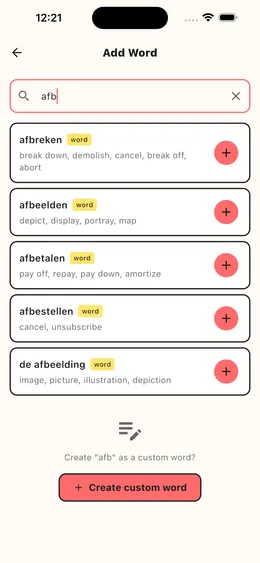
PolyYapp, yes; Memrise, no. In PolyYapp you can search the Dutch dictionary and add any word to your list without an account. If a word is missing, signed-in users can create it: PolyYapp checks it is real Dutch, reduces it to its dictionary form and generates its meanings and grammar. Creating new words is capped at 10 a day and needs Sign in with Apple. Details are on the your own words page.
Memrise’s Dutch vocabulary is whatever the official course teaches. Its help centre mentions Wordlists, but those are lists Memrise curates. User-made courses, the old way to bring your own vocabulary, moved off the Memrise apps on 31 March 2024, and long-time users have reported disappointment at losing them.
How does spaced repetition work in each app?
Both apps use spaced repetition, and they treat a mistake differently. Memrise’s help centre documents a review ladder of 4 hours, 12 hours, 24 hours, 6 days, 12 days, 48 days, 96 days and 6 months, and says a missed item goes back to the first interval. PolyYapp uses its own 14-level ladder, from minutes out to 30 days, and a miss drops a word down one level, not back to the start.
The ladders also end in different places. Memrise spaces a well-known item out to 6 months; PolyYapp’s longest gap is 30 days, so it keeps reviewing words you already know more often. That is a trade-off: a gentler penalty for a miss in PolyYapp, against fewer long-term reviews in Memrise.
PolyYapp also shows its working. Each word in My Words has a progress bar for its level and a note saying when it is next due (“due now”, or a review in so many days, hours or minutes), and you can reset, ignore or restore any word, or delete one you created. No comparable per-word controls were documented for Memrise. The full mechanics are on the spaced repetition page.
Grammar on the word card vs phrases in context
PolyYapp’s word card shows grammar where the data has it: de or het for nouns, the plural and diminutive, the past simple and past participle for verbs, a flag on separable verbs, and notes on register such as informal or formal. Its 5 exercise types then move from recognising the word to typing it from audio and filling it into a sentence, unlocking one by one per word. The exercises page lists all five.
Memrise teaches words and phrases inside scenarios, so you meet vocabulary as part of something you would do; one example on its Dutch page has MemBot playing a barista in Amsterdam. That context is a real advantage for phrases.
Is Memrise or PolyYapp free?
PolyYapp is free today, with no in-app purchases and no ads. Memrise is freemium: its App Store listing says the free plan has limited vocabulary lessons, limited videos and conversations, and ads, and that “a subscription is required in order to access all our learning features.” Memrise Pro is an auto-renewing subscription.
Of the 500 most recent US App Store reviews (posted between November 2024 and October 2026, read on 31 October 2026), 56 mention paying or subscriptions, including one that says “Almost every lesson is paywalled by pro.” Another 51 mention AI; some of them complain about its quality or about the app leaning on it. A further 28 mention crashes, freezes or bugs, and some users report trouble restoring old lifetime purchases. PolyYapp’s privacy policy reserves the right to add in-app purchases later, so its free status describes today, not a promise.
Which devices and languages does each app support?
Memrise reaches further. It runs on iPhone, iPad, Android and the web with one synced account, and teaches several languages besides Dutch. PolyYapp runs on iPhone and iPad, and on Apple-silicon Macs as the iPad app. PolyYapp has no Android or web version, and it teaches Dutch only.
PolyYapp’s counterweight is the language you learn from. One setting shows its interface and Dutch meanings in any of 7 languages (English, Spanish, French, Polish, Russian, Turkish and Ukrainian), so a Turkish speaker studies Dutch from Turkish. Memrise’s interface follows the device language, but which base languages its Dutch course supports is not documented. Neither app documents offline study, and PolyYapp needs an internet connection.
When should you pick Memrise instead of PolyYapp?
Pick Memrise if you want to hear and see real Dutch speakers and practise speaking out loud in realistic scenarios. If your goal is listening comprehension and conversational confidence (ordering, small talk with a partner’s family, work situations), its native-speaker video and AI conversation partner offer something PolyYapp does not. PolyYapp trains vocabulary with text and audio exercises and has no video and no speaking practice.
Memrise is also the better pick if you need Android or a web app, or if you are learning several languages and want one app for all of them.
When is PolyYapp the better choice?
Pick PolyYapp if your problem is vocabulary: you understand the structure of a Dutch sentence but keep blanking on words, or you meet words at work, in letters or in a Memrise video and want them in a review schedule. PolyYapp lets you add those words, shows de or het and the forms where the data has them, and tells you when each word is due.
It also suits learners who would rather start without an account, ads or a subscription, and those who want Dutch meanings in Spanish, Polish, Russian, Turkish, Ukrainian or French rather than English. PolyYapp is not a full course, though: it has no grammar lessons and no exam mode, so pair it with a course, a class or a teacher.
What this page could not confirm
Memrise does not publish several things this comparison would ideally include. The number of levels, lessons or words in its Dutch course is not stated, and neither is which base languages can take that course. Offline study is not documented on the free plan or on Pro. Whether any lessons work before you create an account was not confirmed. The listing says Pro features vary by language pair, so whether Pro unlocks the entire Dutch course is unverified. The separate community-courses site, due to close at the end of 2025, now redirects to a sign-in page, and its status beyond that is unknown.
Questions
Do I need an account for Memrise or PolyYapp?
Memrise appears to need one: its Dutch page and help centre describe signing in and one account syncing across devices, and Pro is tied to your username. Whether any lessons work before sign-up was not confirmed, and one July 2025 App Store reviewer mentioned trying a guest option. PolyYapp needs no account: the first launch creates an anonymous user, and Sign in with Apple is only needed to create new words and to use the Profile screen.
What happened to Memrise's community courses for Dutch?
On 31 March 2024 user-made courses moved off memrise.com and the Memrise apps to a separate community-courses site, which Memrise later said would run until the end of 2025. On 31 October 2026 that site redirected to a sign-in page. Inside the app, only the official Dutch course is left.
Can I learn Dutch from Turkish or Ukrainian in Memrise?
Not documented. Memrise's help centre says the interface follows your device language and that Pro features can vary by language pair, but it does not list which base languages can take the Dutch course. PolyYapp shows its interface and Dutch meanings in English, Spanish, French, Polish, Russian, Turkish or Ukrainian, chosen in one setting.
Does Memrise or PolyYapp work offline?
Neither documents offline study. Memrise's Dutch page and help centre do not mention it, and one App Store reviewer in January 2026 asked for downloadable courses. PolyYapp needs an internet connection to start and to load lessons, words and audio.
Can I use PolyYapp and Memrise together?
Yes. They do different jobs: Memrise's scenarios, video and AI conversation cover listening and speaking, and PolyYapp's spaced repetition covers the long tail of words, including ones you pick up from Memrise videos or daily life and add yourself. Using both means Memrise's free-tier limits still apply on that side.